Christmas returns once again to New York, even though it's not December.
El Niño, the subtle colorful 'Christmas Opera' that Reminds New York (and the US) of the Harsh Drama of Migrants' Journey
There will be no lights or trees adorning Fifth Avenue, but the Virgin Mary and the newborn will arrive in the Big Apple on April 23rd. They will be passing through, on an "exile route," on the stage of the Met Opera.

Por:
Lioman Lima
Video La travesía de una familia migrante que por poco pierde su cita para pedir asilo: "Gracias a Dios llegamos"
There will be no lights or trees adorning Fifth Avenue, but the Virgin Mary and the newborn will arrive in the Big Apple on April 23rd. They will be passing through, on an "exile route," on the stage of the Met Opera.
The company, one of the most respected in the world, will premiere El Niño, an opera-oratorio by John Adams ( *) that reinvents the story of Christmas Eve and the exile of the Holy Family.
Premiered in Paris over two decades ago, El Niño is perhaps one of the boldest and deeply rooted social works ever shown in the Lincoln Center's trio of theaters in its history.
With Marin Alsop leading the orchestra and directed by Lileana Cruz-Blain - who is making her debut on the stages of the Met Opera after her career in theater - the production reinvents biblical scenes, from the Annunciation to the exile in Egypt, in a contemporary, painful, and emergent context: that of migrant mothers, who seek and dream of a better future for the fruit of their wombs.
"I think the beauty of this opera is that it somehow reformulates the traditional genre to look at the journey of a mother, carrying her child and seeking security for him," says Cruz-Blain to Univision. "It's the longing of a young woman who carries within her all the future of a life, and that is a metaphor for the future of life itself," she adds.
Although it's not Christmas, the work arrives at a time when its production can uniquely speak to New York: Mary, Joseph, and Jesus will be migrants on the stage of a city that has seen overflowed its shelter capacity, the patience of authorities, and the candor of many after the massive wave of undocumented immigrants that has arrived there in recent months.
"When I'm working on a piece, it has to relate to what we're experiencing. For me, if there's any reason we go to the opera or the theater, it's to understand and struggle with what it means to be alive," says Blain-Cruz.









"My family comes from the Caribbean, from the islands, from Puerto Rico and Haiti, and when I watch the news, I often only see people traveling in search of security. We are struggling between those who are just trying to find hope. Some of them succeeded, others failed. I think that is so devastating...", she says.
"And particularly living in a city like New York, which is also a place that has brought in so many immigrants and people who, again, seek security... There's something that seemed immediate to me in that within the themes of the opera itself and also what we need to talk about right now," she adds.
For Blain-Cruz, this opera could be a way to connect in time, through art, a biblical story that is close to many with a reality that, for many others, might be indifferent.
"When you think of the biblical story, you think of people fleeing, of evil kings and dictators seeking to harm them, while they try to find security. And you think of this immediate moment when people literally flee to try to find the same thing. For me, this opera invites us to celebrate their humanity and heroism in undertaking that journey," she points out.
The director comments that the opera not only seeks to convey and empathize with the reasons why many emigrate, but also with the challenges of the journey and the reality that sometimes awaits them at the longed-for ports of destination.
"Think of the devastating images we've seen recently of people crossing rivers and being met by men on horseback, treating them as if they were not human. That's why, for me, it was so important to place these people, those seeking security, at the center of the opera, and therefore, as the central representation of our humanity," she asserts.
Latin America, in the Mirror
The drama of those who emigrate will be just one of many current topics explored by El Niño, an opera where the sometimes painful reality of Latin America will be highlighted by the libretto by Peter Sellars, who combines apocryphal gospels with some of the most exquisite voices of Latin American literature, from Sor Juana Inés de la Cruz to Rubén Darío, passing through Gabriela Mistral or Vicente Huidobro.
Their poems will be in Spanish, in a new wave opened by the recent Florencia en el Amazonas, in which the language of Cervantes gains prominence on the stage of the Met Opera.
"It's a tribute to Spanish and the influence that Latin culture has in the USA. But it's also an opera that speaks of authoritarian regimes, the challenges of this changing world, of themes such as feminism or racism," says Blain-Cruz.
And for her, a central figure in that exploration will be the character of the Virgin Mary. Although in the opera, there will be two of them: one, contrary to the most classic representations, will be black.
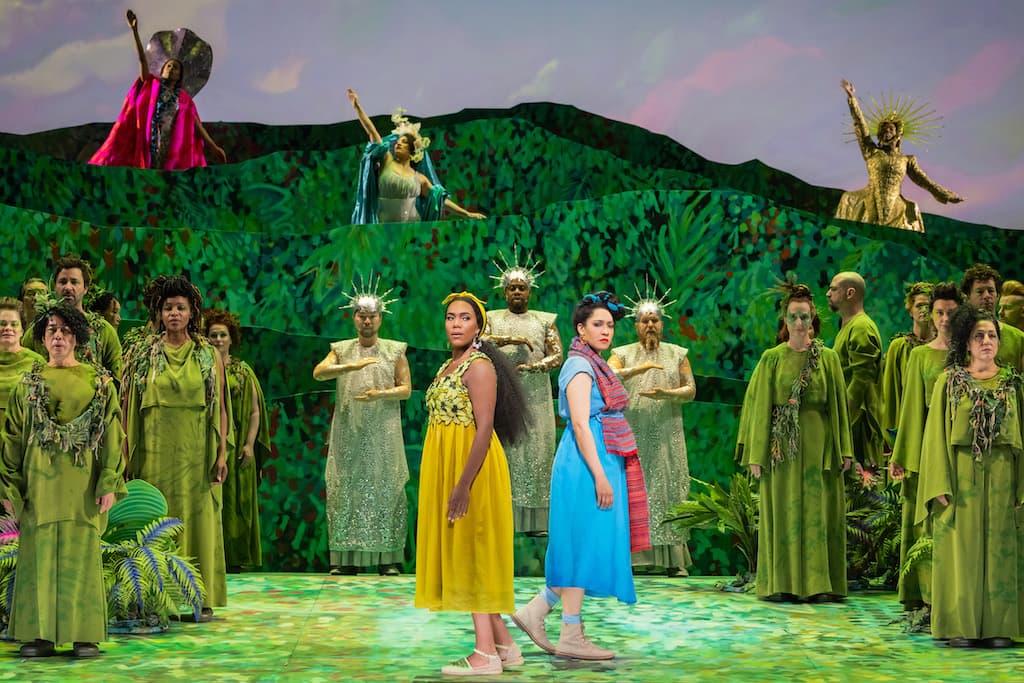
Imagen Evan Zimmerman
"When I think of who the ultimate representation of that story is, I think it's Mary. And in this work, we see two different Marys, traveling along two different routes. One is an Afro-Caribbean Mary, traveling by sea, and the other, a Latin American Mary, traveling by land. The two meet in the second act of the opera, where we see the two different communities coinciding with each other. And that seems wonderful to me to highlight it because there are people who travel from all over the world and somehow end up on the same path, at the same border," she says.
Three people of color are responsible for starring in this recreation of the Christmas story, which also breaks the molds of how the Holy Family has been physically conceived throughout history: soprano Julia Bullock, mezzo-soprano J'Nai Bridges, and bass-baritone Davóne Tines.
"As it is a work that also speaks of diversity, it seemed important to me to honor that presence within this world in terms of who sings, who represents them physically," says Blain-Cruz.
"There is the idea that opera is a thing of the past, but I think it can also speak beautifully and powerfully of the present. And that's what excites me about bringing this to the stage, that we can experience all the epic journeys of these people in a way that elevates them and highlights their heroism, their beauty, their connection with world history in a way that, hopefully, creates empathy and a sense of love," she adds.
This new production will be on stage at the Met Opera New York from April 23-May 17.
( *) Note from the editor: A previous version of this article misspelled the last name of John Adams.