
One morning last February, the sun had barely overcome the thick fog covering Anapólis, a city in the interior of Goiás state in midwestern Brazil. It was still dark at 6:30 a.m. when Edineia dos Santos, 27, arrived at the Anapólis Tribunal.
When justice falls short: Brazil needs 10,000 more public defenders
For every public attorney in the country, Brazil has two prosecutors and two judges. Thirty years after the country’s public defense system was created, the right to free legal assistance is nearly inaccessible for society’s most vulnerable citizens.
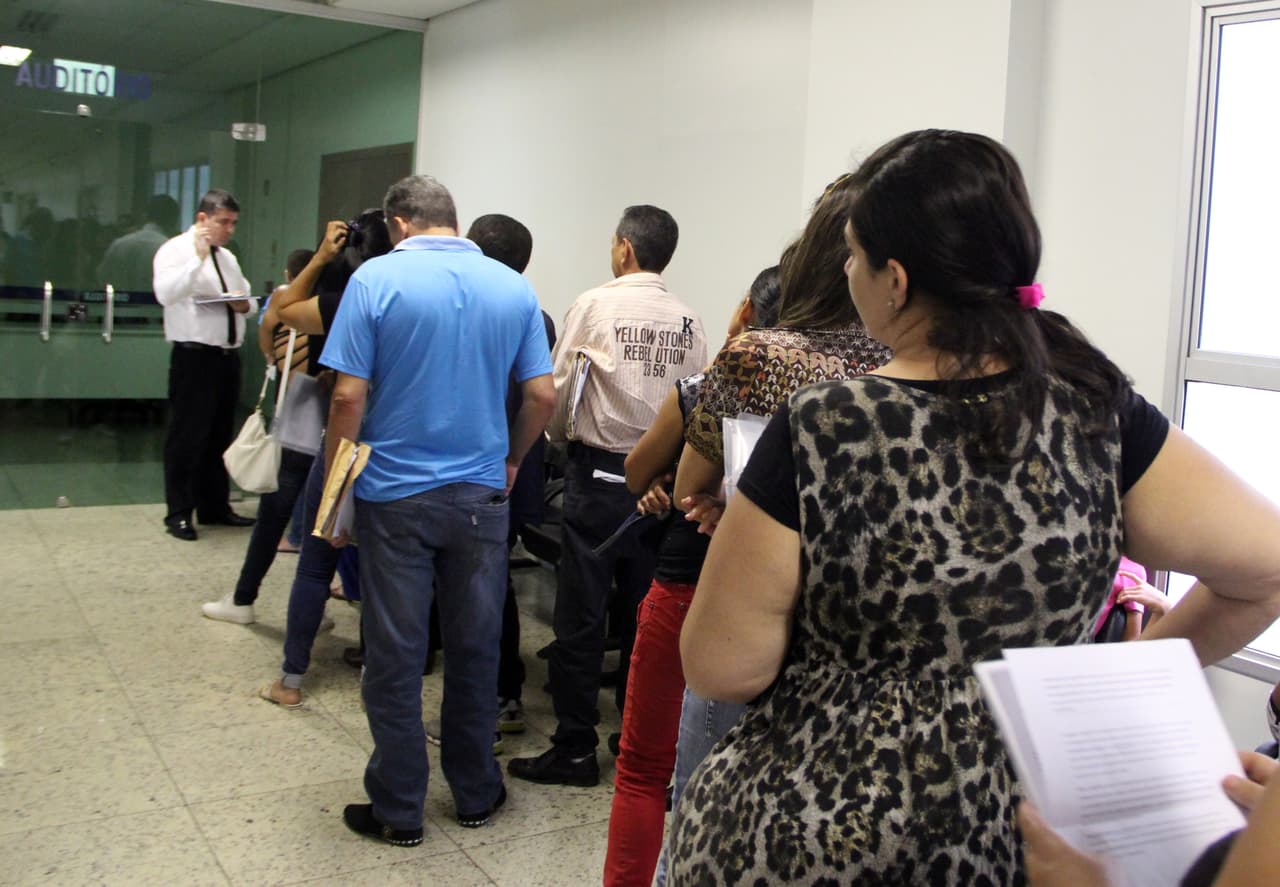
Long lines of people waiting for legal aid at the Goiânia Public Defender’s Office in Goiás state are an everyday occurrence. In Brazil, 10,000 additional public defenders are needed to guarantee adequate service for people with low incomes.
Imagen Luiz da Luz
Five people were already waiting in front of the imposing building, a symbol of the city’s judicial power. It was Edineia’s third attempt to obtain legal help at the only public defender’s office operating outside the state capital.
Because the city has only one public defender, who also serves as a legal advocate for victims, people begin taking numbers for their place in line at 8 a.m., when the office opens. They arrive early in the morning to line up two hours before doors open. Forty numbers are passed out each day, 20 for each shift.
“If you arrive after 6:30 a.m., you won’t get an appointment,” Edineia says.
Goiás’ small public defender’s office is shared by a public attorney and three attorneys from the regional section of the Brazilian Attorneys Association, which provides “dative defense,” a term describing private defense attorneys and legal advocates who are contracted with public funds to assist the country’s poorest residents. Together, the public defender and the “datives” manage 20 cases per shift.
Edineia is trying to help his younger brother, who was arrested 12 days ago. Edineia hasn’t been able to talk to his brother since his arrest. All he knows is that an anonymous complaint led police to search a grocery store where his brother lived and worked. During the raid, police found a weapon and charged Edineia’s brother with illegal possession of a firearm.
“He was never involved with anything bad,” Edineia says of his brother.
While he waits, others leave the building without an appointment with attorneys. One of them is Terezinha de Fátima, 54, who arrived with her husband to seek child support from their daughter, the mother of the couple’s 12-year-old grandson.
The couple has raised him since he was born. But now they are having trouble making ends meet, so they decided to seek help from their daughter.
“I’ll try again tomorrow,” Fátima says as she leaves the building. “I’ll have to get here earlier.”
After four hours of waiting, Edineia was finally able to meet with an attorney for half an hour.
“I don’t really think [the attorney] explained very much. The most concrete thing he said was that my brother won’t be out of jail for at least a month,” Edineia said, resigned.
Twice as many judges as public defenders
Edineia and Terezinha’s struggles aren’t exclusive to Goiás. Despite being a constitutional guarantee for nearly 30 years, the right to free and effective legal counsel in Brazil is, to a significant degree, inaccessible for people with low income. And there aren’t enough public defenders, especially in the country’s interior.
“The situation in Anapólis is unstable. We have to fix it,” said Goiás public defense coordinator Marcio Moreira.
Brazil currently has 5,842 state public defenders and victims’ advocates who work in 26 states and the federal capital. To get a sense of this disproportion, in the same jurisdictions the country has 11,807 judges and 10,847 prosecutors. In other words, the judicial system’s two other institutions have double the number of staff as the Public Defender’s Office.
Public defenders assist poor people, and their area of coverage is enormous. According to the 2015 National Household Survey published by the Brazilian Institute of Geography and Statistics, about 100 million people over the age of 15 live in poverty in Brazil.
In 2013, the Institute for Applied Economic Research (IPEA) used statistics from the National Association of Public Defenders (ANADEP) to estimate the number of public defenders needed for every 10,000 people who live with less than three minimum salaries ($900). That is the criteria the Justice Ministry uses, because in order to receive free assistance, a lack of financial resources must be demonstrated.
The study identified a shortage of 10,578 public defenders in all of Brazil. Four years later, while a few additional attorneys have been hired, the shortage is at least 9,790. And public demand for attorneys is substantial. The 2015 household survey estimated that 100 million people older than 15 have an income below three minimum salaries.
This shows that public defenders’ average national coverage by judicial district is barely 40%, according to ANADEP’s most recent evaluation. Only the Federal District, Rio de Janeiro, Tocantins and Roraima have at least one public defender in all of their districts.
Thousands depend on free legal counseling
In Brazil, public attorneys are not only tasked with defending people facing criminal charges, who actually comprise the fewest number of cases. Most cases involve people who need legal assistance to settle divorces, separations, custody battles, child support and alimony claims (which are Family Court issues), and problems in the health care system. These include a lack of hospital beds, prescription drug shortages and long waits for surgeries.
While the lack of available assistance is clear in Anapólis, in the capital of Goiás, efforts are noticeably different. Different assistance booths divided by area are located in four parts of the city, with staff to spot and guide those looking for help. This type of organization allows people like Helena Braga to bring matters of life and death to the attention of public legal advocates.





Braga, a 60-year-old retired nurse, went to Goiás’ public defender’s office on Feb. 13 to seek help for a friend, Eudália Brito da Silva. Eudália’s life has been devastated by the autoimmune disease lupus.
Eudália and Helena met at the Tabernáculo da Fé church in the region of Ipiranga, in 2007. At one of the church’s many get-togethers, Eudália learned that as a nurse, Helena often provided basic medical care to church members. Eudália asked Helena for help to treat the sores that lupus had begun to leave all over her skin.
“She had so many sores on her leg that her skin was raw. She cried from the pain, and I cried with her while she was healing,” Helena said.
For Eudália, a 38-year-old assistant cook, the annual cost of living without 24-hour care is 37,821 reales ($11,800). That’s the price of prescription drugs to help manage her symptoms.
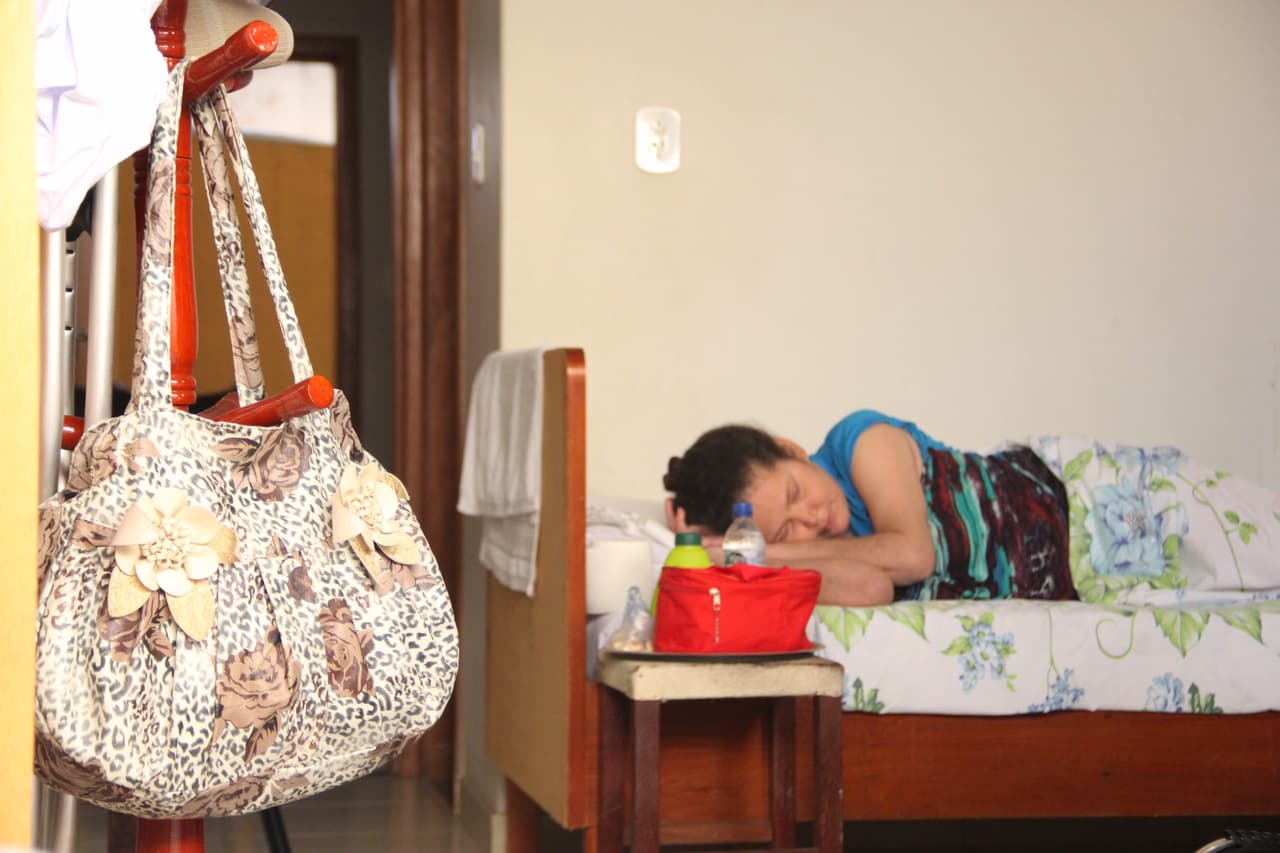
Eudália Brito da Silva has lupus and spends her days bedridden. The prescription drug she needs to control her symptoms costs $11,800 a year. The Goiânia Public Defender’s Office managed to convince a judge to order the state of Goiás to provide her medication, but as of March, the state hadn’t complied.
Imagen Luiz da Luz
The disease gradually caused Eudália’s health to worsen. She decided to seek monthly treatment at the Goiânia General Hospital. But the hospital unit where she was treated moved in 2014, and she was no longer able to get steady care. In mid-2016, her condition worsened, leaving her hospitalized for several weeks.
In addition to the lesions on her skin, Eudália began to develop microfractures in her bones. She required assistance for the simplest of tasks. She couldn't eat, walk or take care of her basic hygiene.
Because Eudália has no family in Goiânia, a local church took her in. She now lives in a small room in the church, where she is bedridden, constantly tossing and turning to find a position that makes the pain a little more bearable. On the worst days in the hospital, she was given morphine, she said.
While the disease consumes her, Eudália could improve with a medication called Teriparatida, which costs $900 a month. But since leaving the hospital last December, she has been unable to obtain the drug through the Unified Health System, which provides free health care services. So her friend Helena decided to turn to the local public defender’s office for help.
With the help of a public defender, on Jan. 21, a court ordered health care workers in Goiás to provide Eudália with her medication. But as of late March, the government hadn’t complied with the order and Eudália has not yet received her medication.
Thousands of cases like this exist. In 2016, the Goiás Public Defender’s Office received 11,572 calls to its civil section, which included anything from problems related to consumer rights to requests for help with health care issues.
When patients fail to get adequate assistance from the public health care system, they seek help from the courts.
“Without a doubt, that’s the area that generates the greatest challenges,” said Ricardo Batista, president of the National Public Defenders Association.
Among the most important changes that are needed, says Batista, is making the health care system more effective without interfering with the judicial branch.
“A court order isn’t going to make the system function day and night. This system, which already was overburdened, is now overwhelmed by judicial orders that aren’t being complied with,” he said.
A constant struggle
The country’s first Public Defender’s Office opened in Rio de Janeiro in 1954, when the state served as the federal capital. Three decades later, in 1981, another was opened in Minas Gerais, in the southeastern region. By 1988, public defender’s offices had been opened in Mato Grosso do Sul, Piauí, Bahia and the Federal District.
Before that, in states that didn’t have a public defender’s office, access to justice for poor residents was assigned to a section of offices at the Public Prosecutor’s Office, which formed the first level of the states’ executive branch.
But the impetus for expanding the Public Defender’s Office nationally was the establishment of free legal services as a right by Brazil’s Constitution of 1988, after the military dictatorship came to an end.
The speed with which this service is extended across the country depends on political will. Each state must create and operate its own public defense offices. But that bureaucratic process is political, and it depends on negotiations that are often extremely slow.
In Goiás, where Edineia and Terezinha sought help, the public defender’s office opened its doors only two years ago.
“We have public defender’s offices that have been operating for years, and even the newest ones [in Paraná and Santa Catarina] are badly structured. The new ones have only a small number of attorneys who earn low salaries, making it hard to fill the positions. But also the oldest offices, such as in Paraíba, still don’t have enough attorneys, nor do they have the support staff they need,” ANADEP President Antonio Maffezoli said.
Because denying assistance to the poor is unconstitutional, years ago state authorities reached agreements with regional offices of the Brazilian Attorneys Association (OAB) to provide service via the concept of “dative defender.” This became another issue of contention in the creation of the public defender’s offices.
In many states – including São Paulo, Brazil’s most heavily populated, which opened its public defender’s office in 2006 – public attorneys compete with private attorneys for funding of their services. But the country lacks a registry of the number of attorneys who work under the concept of “dative defender.”
This situation prompted São Paulo to create its own public defender’s office in 2006. But the OAB battles public defenders for part of judicial branch’s funds. The shortage of funding is one of the main problems preventing public defender’s offices from expanding in Brazil’s interior. After each state creates them, public defender’s offices are suffocated by minimal funding. Additionally, a political battle ensues each year over funds, according to Batista, who also is the Federal District’s general public adviser and president of public defense at the National University.
For example, the annual operating budget drafted by each public defender’s office must coincide with the budget proposal issued by the state executive branch and other judiciary institutions, such as the Tribunal of Justice and the Prosecutor’s Office. Then, the budget almost always is cut by the Legislative Assembly.
“Since 2012 (when Batista started in his current position), I never had a budget from the Public Defender’s Office presented to the Assembly by the executive branch that was aligned with what we asked for at the start,” Batista said.
This situation occurs in Goiás, where the institution is waiting for the government to assign 27 public defenders approved in a public contracting process in order to open offices in other cities. But that approval depends on the will of Gov. Marconi Perillo.
That’s why public defenders want to change the law in Goiás, to become independent of the political system and have more freedom to operate.
“We can’t attack head-on yet. We have to go slowly to get what we want, which is approval of a new law. We have to proceed very carefully to obtain this autonomy,” said Goiás’ defender general Lucía Silva Gomes Moreira.
Political appointments
In some states, public defense is almost a political entity. That is true in Amapá, a border territory in the Brazilian Amazon, in the country’s north, that is nearly entirely covered in jungle. There, 782,295 people have waited nearly 30 years for the creation of a state public defender’s office.
The incomes of at least a third of the population there are less than three minimum salaries. These are the public defender’s office’s target clients. In Amapá, at least 53 public defenders are needed to guarantee quality service, according to an IPEA study.
But the problem in Amapá isn’t the number of public attorneys – there are 100, public defender general Horacio Magalhaessino said – but rather the manner in which they were selected and their ability to act independently.
To avoid outside influence on their work, public defenders are chosen by a public contracting process. They are required to work exclusively at the institution. But that’s not the case at Amapá’s Public Defender’s Office, created by decree by Gov. Aníbal Barcellos in 1991. The professionals responsible for representing poor clients charged with crimes were not selected by a public contracting process, but by the governor himself.
“It’s truly the public’s loss in Amapá”, Maffezoli said.
His criticism is based on the fact that occasionally the institution has to participate in cases against representatives of the state’s executive, including the governor, making it impossible to always maintain independence.
Following pressure from ANADEP, the state promised to promote a public contracting process to replace its public defenders. But so far, that hasn’t happened. Magalhaessino believes that selection process could happen in the second half of this year.
We’ll see.
***