Venezuela is holding state and local elections on Sunday, in a new and tentative effort to put the country back on the democratic path after more than two decades of increasingly corrupt and authoritarian rule.
Venezuela takes “a small step” towards democracy in Sunday’s local elections
After four years of boycotting elections the opposition is returning to the ballot box in Sunday's elections for governors and municipalities. But expectations are low with many viewing the vote as preparation for presidential elections in 2024. (Leer es español)
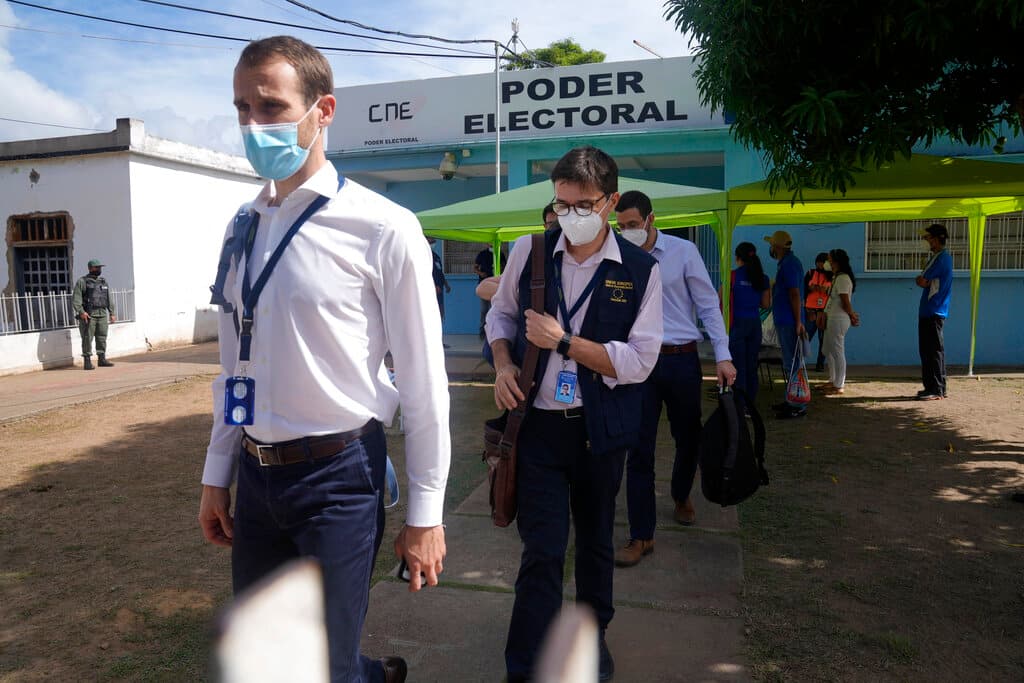
E.U. Election Observation Mission members leave the National Electoral Council, CNE, headquarters in Ciudad Bolivar, Venezuela, Wednesday, Nov 17, 2021.
Imagen Ariana Cubillos/AP
Despite enormous obstacles and allegations of grossly unfair electoral conditions favoring the government candidates, the main opposition parties are fielding candidates for the first time in four years.
“It’s important. It’s a major change in strategy,” said Phil Gunson, a senior Andean analyst based in Venezuela for the International Crisis Group (ICG) which advocates for the peaceful resolution of conflicts.
“Before the view was elections were a sham and their only strategy was to pressure Maduro with international pressure. That didn’t work,” he added.
The opposition boycotted presidential elections in 2018 and a parliamentary vote in 2020, alleging electoral fraud by President Nicolas Maduro and his ruling Socialist party.
In another change, the election is also being monitored by international experts from the European Union, the United Nations and the Carter Center, in an effort by the government of Nicolas Maduro to win some international credibility and roll back U.S.-led economic sanctions.
Most analysts agree that the opposition decision to participate could be a step in the right direction, though expectations remain low.
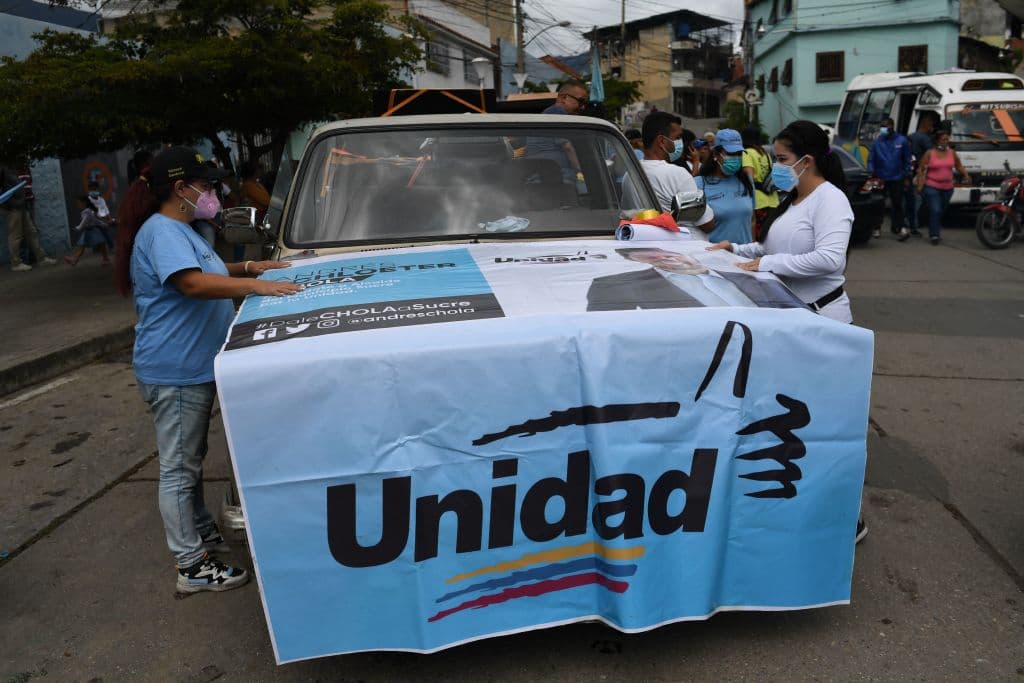
Opposition activists attend a rally on the start of the electoral campaign for the regional and municipal elections in Caracas, on October 28, 2021.
Imagen FEDERICO PARRA/AFP via Getty Images
"A small step"
The U.S. State Department’s secretary for the Andean region, Kevin O’Reilly, this week called the election “a small step, just an incremental step, toward democracy.”
But he clarified that, added: “Conditions for free and fair elections in Venezuela do not exist. Mr. Maduro has already failed that test.”
Elliott Abrams, the U.S. Special Envoy for Venezuela under President Donald Trump, told Univision Noticias that the opposition made the right decision to return to the ballot box. The opposition needed to “appeal to the citizenry to exercise the muscle memory of voting,” prior to the next presidential vote in 2024, he said.
But he too was not optimistic. “I don’t think this election brings us one step closer to restoring democracy in Venezuela,” he added, pointing to the background of fraud and political repression by Maduro’s and his United Socialist Party of Venezuela (PSUV).
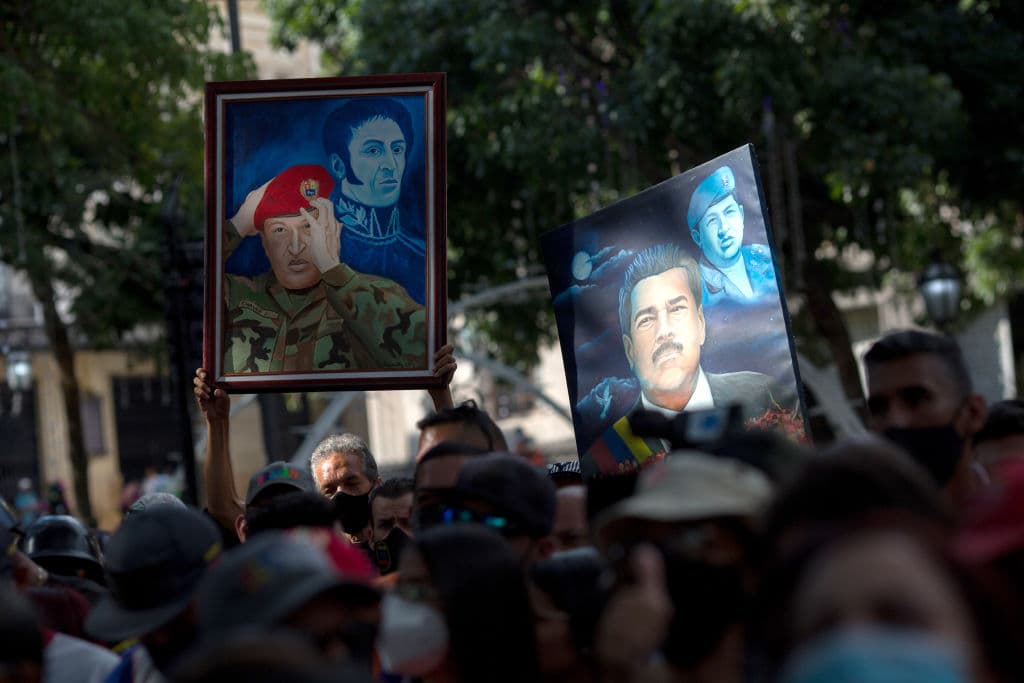
A man holds a painting of President of Venezuela Nicolas Maduro and late President Hugo Chavez during a rally in support of Alex Saab at Bolivar Square on October 17, 2021 in Caracas, Venezuela.
Imagen Getty Images/Getty Images


Electoral conditions
To be sure, the opposition faces an enormous task. While electoral conditions have improved, they remain far from free and fair, according to the nonpartisan Venezuelan Electoral Observatory. The Maduro regime controls the state media, hold 250 political prisoners, has disallowed some opposition candidates from standing for office, disqualified political parties and seized control of others to confuse voters and dilute the opposition vote.
“It’s a political reality. No hay mucho que esperar,” said Gustavo Marcano, the exiled former mayor of Chacao, an upscale district in Caracas. “No-one should have any illsions that this is the end of Maduro. Pero estamos mas cerca de tener elecciones presidenciales (en 2024) and we have to keep pressuring,” he added.
Elections on Sunday will determine over 3,000 local seats, including 23 state governors, and control of 335 municipalities, with some 21 million Venezuelans eligible to vote.
Divided opposition
In the absence of reliable polling the outcome remains highly uncertain, though expectations regarding major opposition gains are low, in part because the opposition remains deeply divided and suspicious of the process.
Abstention - and migration – are expected to hurt the opposition. More than six million Venezuelans – mostly opponents of Maduro - have migrated from the country of 28 million people in the last decade, accounting for perhaps as many as 15% of eligible voters.
Video Adiós Venezuela
Because the opposition boycotted the last two elections it lacks on the ground operatives. The parties also agreed to contest the election late in the process with barely any time to select candidate and organize campaigns.
“They are very much starting over and they have lost a lot of militants at the grass roots,” said Gunson.
With 2024 on the electoral horizon, “they have to start rebuilding now,” said Gunson. “It’s only three years away and they are in really bad shape,” he added.
The results could also play an important role in restarting a suspended national dialogue in Mexico between the government and the opposition. If observers give a negative report that could undermine Maduro’s negotiating position and hap more international pressure on him.
Besides the U.S.-led sanctions, the International Criminal Court (ICC) announced earlier this month a formal investigation of the Maduro for serious allegations of crimes against humanity.
Notas Relacionadas
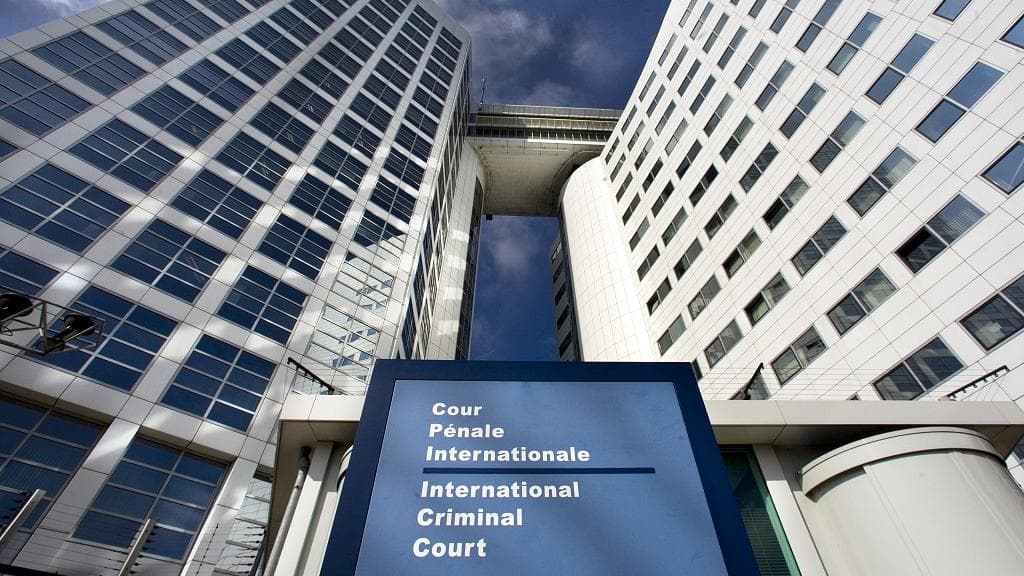
Venezuela facing unprecedented accusations of crimes against humanity
Univision News
11 min
Juan Guaidó
The elections results could also spell trouble for Juan Guaidó, the leader of the opposition, who is recognized since 2019 as the nation’s legitimate president by many countries around the world. His term as ‘interim president’ expires in January, and some are already questioning if his days might be numbered.
Some in the opposition are already sensing weakness in Guaidó’s camp due to the loss of control over management of once lucrative state-owned petrochemical companies that came under opposition control in 2019.
That includes irregularities at a state-owned fertilizer company, Monómeros, located in Colombia, that has implicated some opposition figures.
Its greatest asset, the U.S.-based oil refiner Citgo, is also facing a court-ordered auction, or bankruptcy, due to pressure from bondholders and other creditors seeking to recover their money in U.S. court.
With very little voter enthusiasm and a low turn-out expected, analysts say the results are unlikely to reflect well on anyone, even if the government claims victory.
Notas Relacionadas
Legal battle over Venezuela's looted billions heats up
Latin America
12 min
"Venezuelans feel like orphans"
Instead, independent analysts say they hope Sunday’s election marks the turning of a new page that forces political parties to rethink their leadership and strategies.
"The national polls and the testimonies we collect in the streets show a disaffection with politics," said Mariela Ramírez, spokeswoman for the Civic Forum (Foro Cívico) a Venezuelan pro-democracy group, during a virtual discussion organized this week by the Atlantic Council.
"None of the main party leaders across the national political spectrum today has the approval of the vast majorities. Venezuelans feel like orphans," she added, describing the shocking living conditions in recent years, lack of medicines, the hunger and the extraordinary levels of violence.
Instead, Venezuelan voters are desperate for new leaders who reflect the urgent social needs they face, rather than the traditional ideological slogans regarding socialism, capitalism and democracy.
"It is urgent to initiate as soon as possible a process whose main imperative is to take into account the effect of the conflict on the victims and provide solutions to the drama that the citizens are living," said Ramírez.
"Politics has a debt with the country and as long as the citizens do not feel listened to, the disenchantment with the party politics will continue to deepen... a process that in the long run will undoubtedly have a political expression because Venezuela will end up giving birth to new leaders."
Relacionados: