On February 7, Ecuador kicks off a busy electoral year in Latin America with elections for president and its legislative body, in the hemisphere’s first test of voter sentiment a year into the pandemic.
Could elections in Ecuador be first sign of a resurgence of populism in Latin America?
On Sunday, Ecuador will hold its general elections for President and National Assembly. Analysts will be watching closely to see if populist candidates are swept back to power in the midst of a deep, covid-fueled, regional economic crisis. (Leer en español)
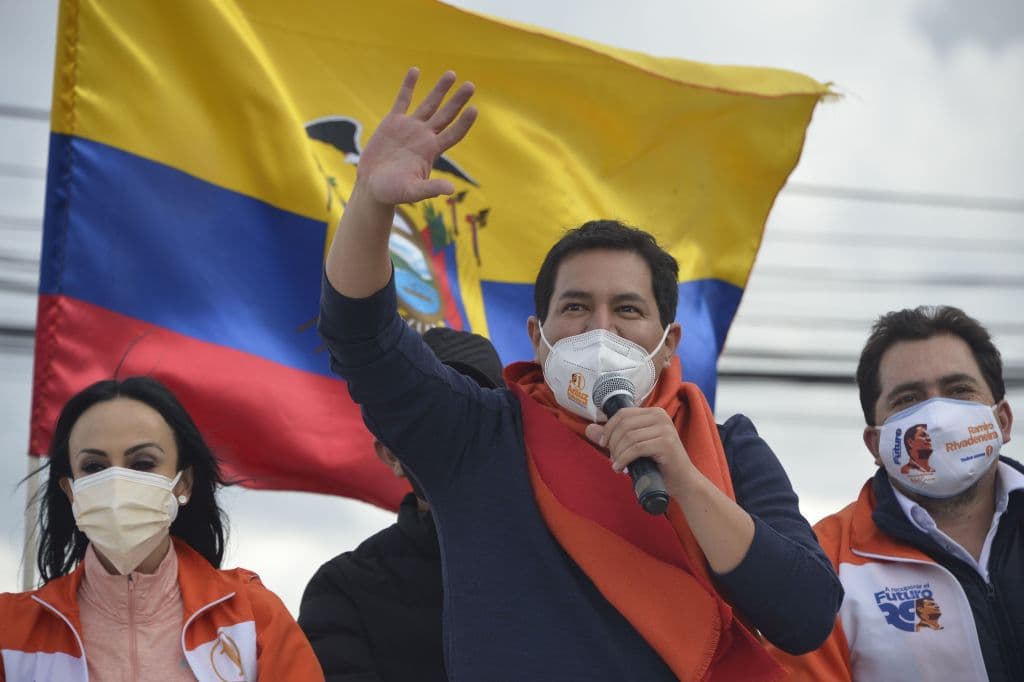
Ecuadoran Presidential candidate for "Union por la Esperanza" party Andres Arauz (C), speaks to supporters during a campaign rally in northern Quito, on January 6, 2021.
Imagen Rodrigo Buendia/AFP via Getty Images
In all, nine Latin American countries hold elections in 2021, with the economic impact of covid-19 – and the slow rollout of vaccines - likely to be a determining factor in each one, and observers pointing to the likelihood of a rise of populism.
Presidential votes are also due in Peru (April), Chile (Nov), Honduras (Nov) Nicaragua (Nov), as well as midterms in El Salvador (Feb 28), Mexico (June) and Argentina (Oct).
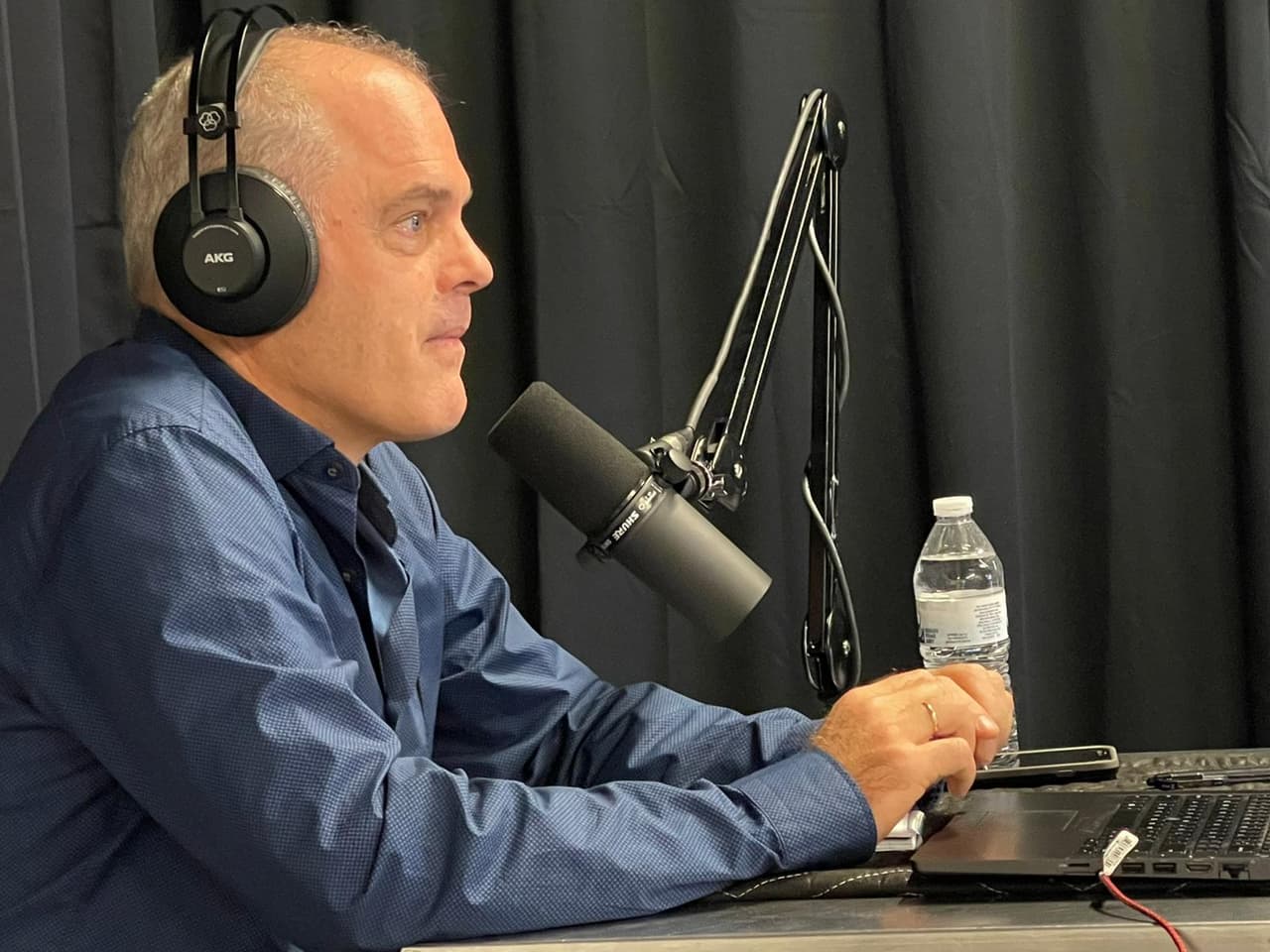
“Ecuador is the first acid test. They are the canary in the coal mine,” said John Price, managing director of the consulting firm Americas Market Intelligence (AMI).
Weaknesses
Economists say the crisis has exposed Latin America’s social and economic weaknesses, including weak public health services, a large informal economy with no social safety net, and poorly diversified economies that are still heavily reliant on commodities such as oil, mining and agriculture.
Mostly importantly perhaps, Latin America is still far behind the rest of the world in digital connectivity. During the pandemic a lack of access to the internet and digital technology has meant fewer people were able to work remotely from home.
“Covid was devastating. If your business was tied to the formal economy, you could move to working remotely from home, and you were ok. Everyone else is screwed,” said Price.
Polls show widespread discontent with the way governments closed down their countries to stop the spread of the coronavirus, including schools, but were unable to provide healthcare coverage and welfare benefits to the most-needy.
“Covid has been pretty badly managed in almost every country and will have a profound and long-lasting effect on the region,” said Michael Shifter, president of the Inter-American Dialogue in Washington DC. “Incumbent government are going to be in trouble and we are headed for a period of sustained instability,” he added.
Class warfare
The exacerbation by covid of economic inequality could lead to increased class warfare, says Price. He points out that in many countries it was well-traveled wealthy business class that introduced the virus to their countries.
“They can protect themselves. They live in islands of security,” he said. It was also the wealthy elites who pressed governments to go into lock down, ignoring the effects on lower income families in the informal sector, he said.
Price and others point to alarming economic and social indicators about the region as a result of the pandemic, including rising poverty and inequality, that could favor populist candidates.
Covid impact
For example, although the 650 million people of Latin America account for only 8% of the planet’s population, it has 28% of the global deaths from covid-19. Five of the top 20 countries in the world for covid infections are in the region: Brazil, Mexico, Colombia, Argentina and Peru.

An abandoned corpse wrapped in plastic and covered with cardboard lies on the sidewalk near an intersection on April 6, 2020 in Guayaquil, Ecuador. Local health services were overwhelmed early on during the pandemic and dead bodies lay uncollected in apartments for days as morgues and hospitals were overcrowded.
Imagen Getty Images/Getty Images
With a 7.7% economic contraction in 2020, Latin America and the Caribbean has been hit harder by the pandemic than any other region in the world, according to the United Nations’ Economic Commission for Latin America and the Caribbean (CEPAL).
The region’s labor market has lost as many as 25-30 million jobs, and the number of those living in poverty increasing by 45.5 million from 185.5 million in 2019 to 230.9 million in 2020, or 37.3% of its total population.
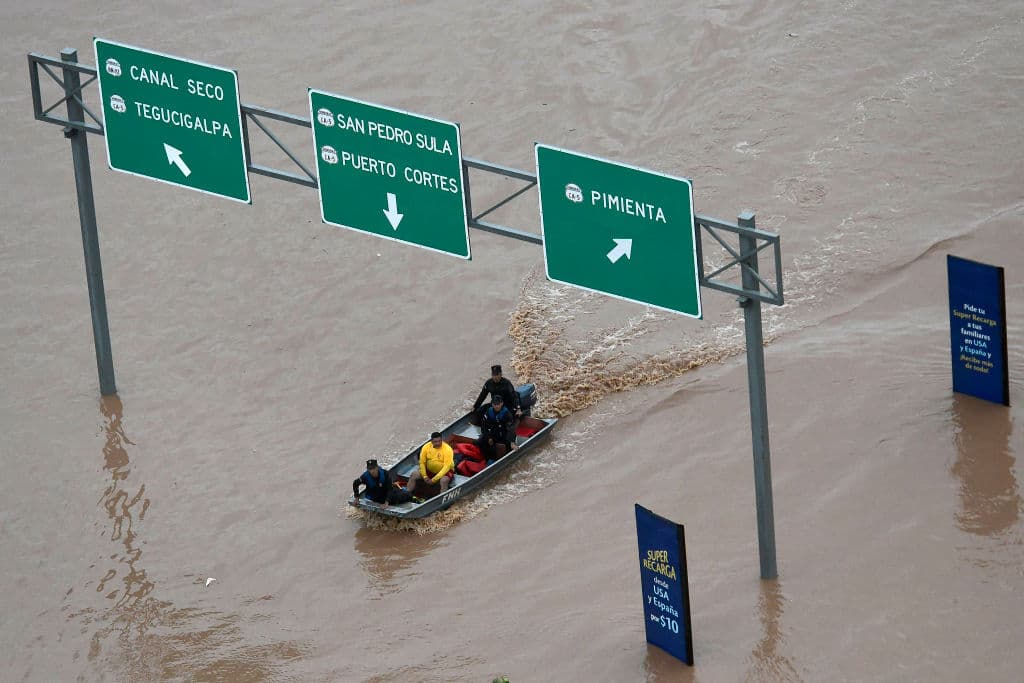
The 2020 hurricane season also broke records, with Eta and Iota and causing devastation in Central America.
Notas Relacionadas
And, if that wasn’t enough, South America is still dealing with the exodus from Venezuela, the largest migration crisis in the world.
Lack of vaccines
To make matters worse, the pandemic could drag on longer in Latin America due to the slow ordering and delivery of vaccines.
“Unfortunately, that initial 10-20% of the vaccination process is going to feel quite slow across Latin America because it is all happening while governments are competing for limited supplies,” according to Bogota-based James Bosworth, author of the LatinAmerica Risk Report.
“The media coverage on that painfully slow process is likely to cause public anger,” he added.
Various consulting firms are estimating that many countries in Latin America won’t be vaccinated until mid to late-2022 or even 2023.

A worker unloads a container from an airplane during the arrival of a shipping with 8,000 doses of the Pfizer-BioNtech Covid-19 vaccine on January 20, 2021 in Quito, Ecuador.
Imagen Franklin Jacome/Getty Images


Informal economy
Only one in every three people in Latin America’s rural areas have Internet access, and 244 million people in Latin America and the Caribbean are without a consistent Internet connection, according to a joint study last year by the Inter-American Institute for Cooperation on Agriculture (IICA), the Inter-American Development Bank (IDB) and Microsoft.
Instead, the hemisphere depends heavily on a low wage, self-employed “informal” sector which employs 60% of workers, according to the International Labor Organization (ILO). There were the worst affected by covid which forced them off the streets making it impossible for them to make a living. As many don’t pay taxes, they were also ineligible for unemployment benefits or government bailouts.
School’s out
On top of that, more than 97% of students across Latin America remain physically out of school because of covid, according to a study by UNICEF.
The impact of a lost academic year could outlast the pandemic itself. A recent study by academics including Nora Lustig with the Commitment to Equity Institute at Tulane University estimated that the high school completion rate in Latin America could decrease by as much as 15-20 percentage points, the study found.
While some governments. Especially Brazil, Peru, Argentina and Chile have offered generous covid relief packages that money is running out and had left governments heavily in debt.
“We are going to see a real anger develop. Governments are going to be trapped,” said Price. “International lenders are going to tell them to return to balancing their finances. That’s going to cause a real disruption,” he added.
China
The risk is that governments may be forced to abandon efforts to diversify their economies to create better paying jobs and return to reliance on the export of unproductive commodities to China.
“China is the only country in the world that has a surplus in its budget and they are ready to tap into this opportunity,” said Gamarra.
“It’s fairly difficult to see how they can avoid it. They have huge debts, they are not getting foreign investment, and it’s going to be hard for them to borrow,” he added.
Mexico
President Andres Manuel Lopez Obrador in Mexico is perhaps the exception. His left-leaning government avoided a generous bailout amid concerns over the finances of the region’s second-largest economy. As many as 10 million people, many from Mexico’s middle class, are expected to tumble into poverty, analysts say.
But Lopez Obrador remains popular. “He seems to have a real connection with the population. “It helps that Mexico has a bankrupt and discredited political class,” said Shifter.
“We learned that with [Hugo] Chavez. Never underestimate the depth of anger towards the old corrupt class,” he added, referring to Venezuela’s former president and left-wing firebrand who died in 2013.
Political pendulum
The recent election of Luis Arce in Bolivia in October provided a sign of what may be to come. After a tumultuous year of political turmoil and the pandemic, the socialists were voted back into power just a year after the party’s leftist leader Evo Morales was ousted amid protests.
Polling showed a big surge is support for Arce after the outbreak of the pandemic, said pollster Eduardo Gamarra. “The pandemic played a part. The measures to shut down the economy hurt the informal sector which is 70% of the economically active population,” he said.
“Governments are torn. On the one hand they are being told to shut down by the WHO (World Health Organization), but on the other they don’t want to send their countries into even deeper recession,” said Gamarra.
Ecuador
In Ecuador, the leading candidate in polls is Andrés Arauz, leader of the Union for Hope (UNES), and an ally of leftist former president Rafael Correa. In a packed filed he is unlikely to win in the first round, and will likely face an April runoff with Guayaquil banker Guillermo Lasso for the conservative alliance Creating Oportunitities.
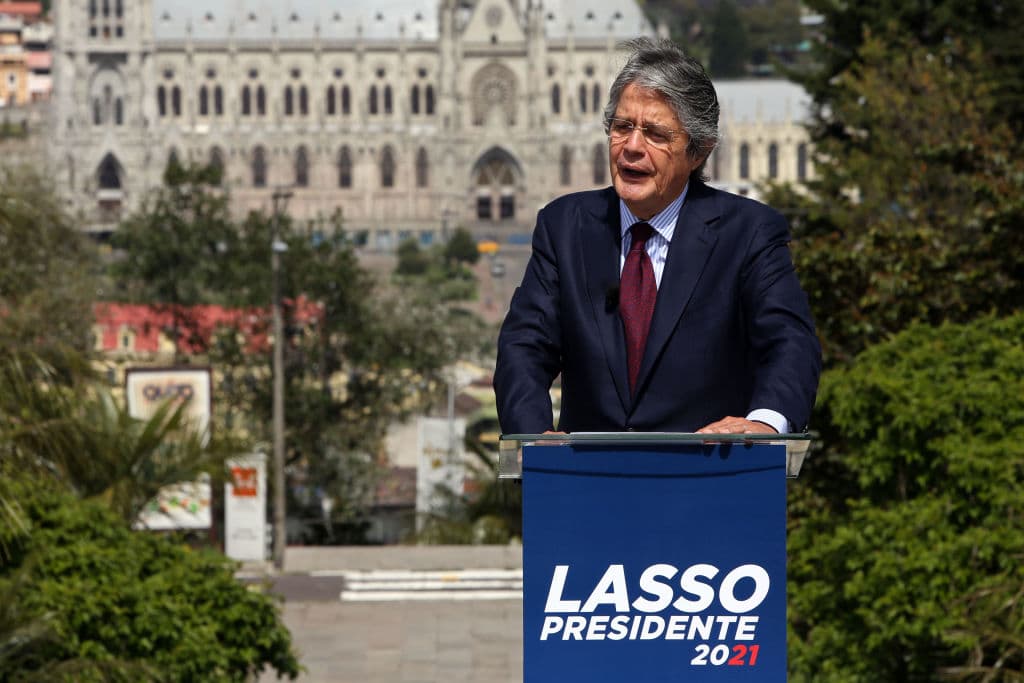
The presidential candidate of the CREO party for the Ecuadorean presidential election, Guillermo Lasso, delivers a speech during the launching of his campaign with limited capacity for the press and supporters, at Itchimbia Park in Quito, on December 31, 2020.
Imagen Cristina Vega Rhor/AFP via Getty Images
“There’s a dire situation in Ecuador where covid has exacerbated an already bad situation,” said Shifter.
Outgoing president, Lenin Moreno, was Correa’s vice-president but abandoned his party’s leftist ideology upon taking office in 2017, adopting a more pro-U.S. platform.
But his government nearly collapsed during violent protests in 2019, and he is now one of the least popular presidents in the region.
Governments on both left and right could be in trouble. “This isn’t so much about left and right. Populism works both ways. When there’s discontent any anti-establishment figure is going to have resonance,” said Shifter.
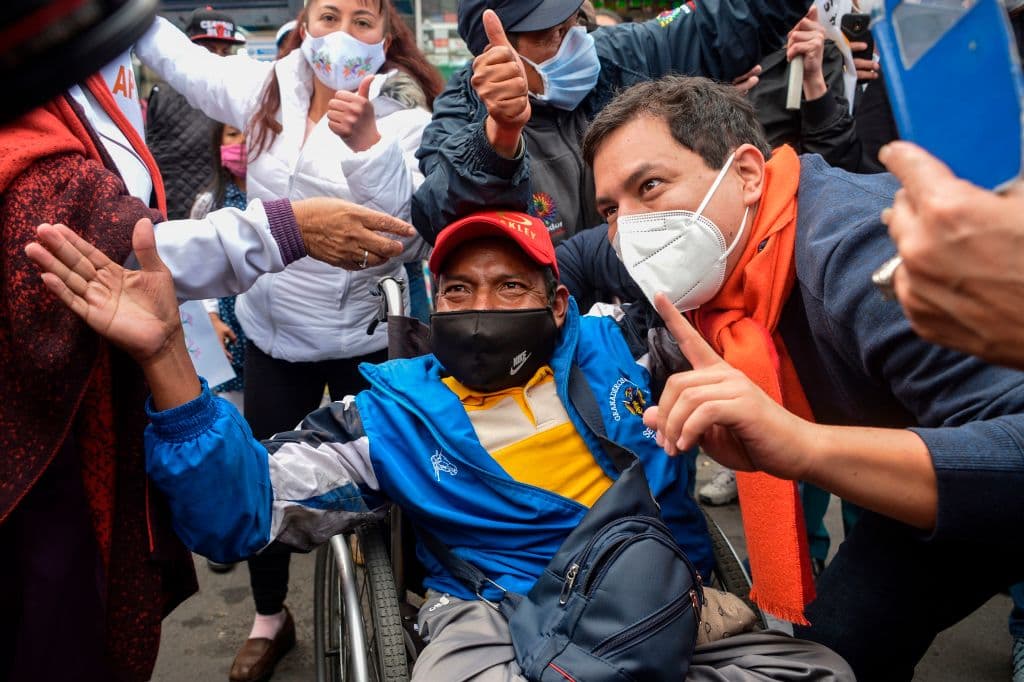
Ecuadoran Presidential candidate for "Union por la Esperanza" party Andres Arauz (R), takes a picture with a supporter during a campaign rally in northern Quito, on January 6, 2021.
Imagen Rodrigo Buendia/AFP via Getty Images
Peru
Peru has gone from being the country with the fastest growing economy to the most unstable politically, with three presidents in two years. While it’s still far too early to tell how the election will go, center-right candidate, George Forsythe, a former soccer goalkeeper, is leading in the polls, although the electorate could rally around leading leftist candidate Veronica Mendoza in a second round.
The biggest test could come in Colombia in May 2022, with leftist Gustavo Petro hoping to improve on his second-place finish in 2018.
Despite one of the highest education rates in Latin America, more than half of Colombia’s economy is informal. Like Mexico, the governmenthas also not expanded existing social assistance for informal workers not covered by existing safety nets.
Solutions
Tackling the health crisis and its economic and social effects will require deep broad political and social changes in the region that “lay the foundations for a welfare state,” including universal access to health, redistributive taxes, increased productivity, better provision of public goods and services,” CEPAL said in a report last October.
“These social compacts will have to be far-reaching agreements that may even culminate in new constitutional processes,” it added.
The Inter-American Development Bank (IDB), has already approved a record $21.6 billion in financing for the region, including $1.2 billion for public health.
The bank, which is the largest source of development financing for the region, has also made $1 billion available to support vaccine acquisition and distribution. “There's going to be a correlation between the speed of recovery and vaccinations in the region,” the IDB's new president, Mauricio Claver-Carone told a leadership forum on Thursday.
Marshall Plan?
Claver-Carone said the region needed a Marshall Plan to rescue it from the effects of the pandemic. That included a $150 billion investment in health, noting that “70% of the deaths in the region could have been prevented with adequate healthcare.”
On the positive side, Claver-Carone said that as a result of the disruption to global trade caused by the outbreak of covid-19 in China, one third of the largest 250 global corporations are planning to move part of their manufacturing operations to other parts of the world by 2023.
If they moved even a fraction of those jobs to Latin America “that would have a huge impact,” he said.
“If Latin America were to capture 15% of what the U.S. imports from its top ten sources outside the Americas, that would increase exports from the region by $72 billion dollars per year,” he said.
In order to capitalize on that, the region needs to improve its own infrastructure to boost intra-regional trade, which is far lower than Europe and Asia.
“Maybe ironically this horrible pandemic is the instigator for this long overdue recalibration,” he said.
Notas Relacionadas
Relacionados: