
For a long time, Virginia was synonymous with Republicans. Until Barack Obama's victory there in 2008, the GOP won the state for 40 consecutive years. For more than 10 presidential elections, Virginia was a comfortable Republican bastion.
How Northern Virginia turned blue and could give Clinton a victory
Counties and towns near Washington, DC, have grown more blue with the arrival of young professionals who tend to lean Democrat.
But the Democratic Party has been gaining ground in Virginia, especially in the northern part of the state, close to Washington, DC.
MANY VOTERS LIVE IN THE STATE'S NORTHERN REGION
With the loss of Northern Virginia, the Republican Party has lost strength in a region with a big chunk of the state's voters. Data from the 2014 census show that the bulk of Virginia voters live in the north. Counties and towns in these areas – highlighted in black in the map below – are home to nearly 1.5 million voters, or about 25 percent of the state's total. They live primarily in Loudoun, Fairfax and Prince Williams Counties, which together registered nearly 300,000 new voters since 2000.


Has Virginia become a Democratic state? Not for now, although it's no longer the GOP redoubt it was for so many decades.
“It's not the capital of the South anymore,” said Gary Nordlinger, a professor at George Washington University. He said Virginia is now a “purple” state, with Democrats and Republicans in nearly equal numbers. Jeremy Mayer, a professor at George Mason University, agreed but added that for now the Democrats appear to have an advantage, with polls showing Hillary Clinton winning the state in November.
Demographic changes can help explain the political shift. Mayer noted that Northern Virginia has had one of the most prosperous economies in the U.S. over the past three decades. The region has benefited from its proximity to the capital, lower taxes and its ability to attract federal funds, which soared from $1.7 billion in 1980 to $38.5 billion in 2009, according to a study by George Mason University professor Stephen Fuller.
The economic boom has attracted many young, highly educated professionals in their 20s and 30s who work in technology and government and tend to lean Democrat, said Nordlinger. The region has also become increasingly diverse with the arrival of more minorities, especially Hispanics and Asians.
The high rents in Washington, DC, also may have pushed professionals to look for homes in adjoining Virginia counties. More than 100,000 people commute every day from Fairfax, Virginia's largest county, to work in Washington, according to official figures from 2013.
Mayer said there's a second factor that helps explain Donald Trump's apparent electoral trouble in Virginia.
The GOP "swung too far to the right” in the 1990s, he said. “The Republican Party that performed well in Virginia was the Republican Party of Senator John Warner, who by today's standards would be a moderate Republican," he added.
Today, the most visible Trump supporter in Virginia is Corey Stewart, the at-large chairman of the Prince William Board of County Supervisors. He's well known for his hardline stance on undocumented immigrants and support for immigration reforms that target Hispanics, said Mayer.
Javier Figueroa contributed to this report.
SOURCES: Census Bureau, Social Explorer, Virginia Department of Elections.
Read more:
Notas Relacionadas
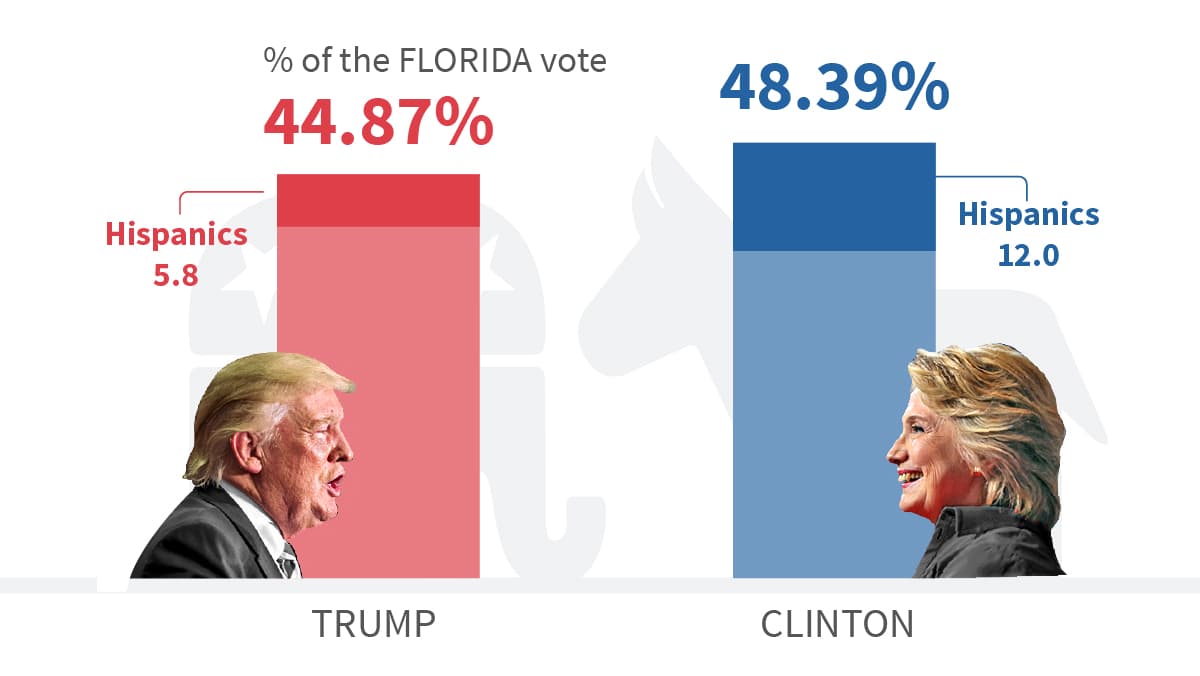
Univision forecast: Latino vote will sink Trump in Florida
Univision News
3 min
Notas Relacionadas

The handful of Florida counties that could decide the 2016 election
Univision News
4 min
Relacionados: