Life, fate, love, joy, sorrow, death… Shakespeare’s most famous romantic tragedy—and perhaps the most enduring in history—returns to dance this autumn on the stage of the Het Muziektheater, home of the Dutch National Ballet in Amsterdam. From October 14 to November 11, the company revives the first full-length ballet ever staged in the Netherlands nearly fifty years ago: Romeo and Juliet, a poignant reminder that some love stories never end—and that some beginnings, like that of the Dutch National Ballet, take flight with a story of love.
Dutch National Ballet’s Romeo and Juliet: Dance, Love, and Tragedy in Amsterdam
Shakespeare’s classic tragedy comes alive on stage as the Dutch National Ballet presents Rudi van Dantzig’s Romeo and Juliet. With dazzling choreography, powerful performances, and enchanting sets, the production captures both the romance and drama of this timeless story.

Por:
Lioman Lima, from Amsterdam

Imagen Dutch National Ballet © Altin Kaftira
Rudi van Dantzig’s choreography preserves the essence of Leonid Lavrovsky’s original and the narrative force of Shakespeare. Yet, guided by Prokofiev’s enchanting score, every movement brims with drama, vitality, and sensitivity, rivaling more widely known productions, such as Kenneth MacMillan’s for The Royal Ballet.
The ballet opens with a village scene, immediately highlighting one of the production’s many achievements: the meticulously crafted sets by the legendary Toer van Schayk. Together with van Dantzig and Hans van Manen, van Schayk helped shape the Dutch National Ballet into one of the world’s leading companies in the latter half of the 20th century.
With a palette of ochres and pastels, van Schayk creates a miniature medieval Verona on stage, where every detail is precise and functional. Each set transforms the space: a bustling square, a Capulet ballroom, Friar Lawrence’s chapel, and the shadowed crypt at the finale, crowned by a death angel.
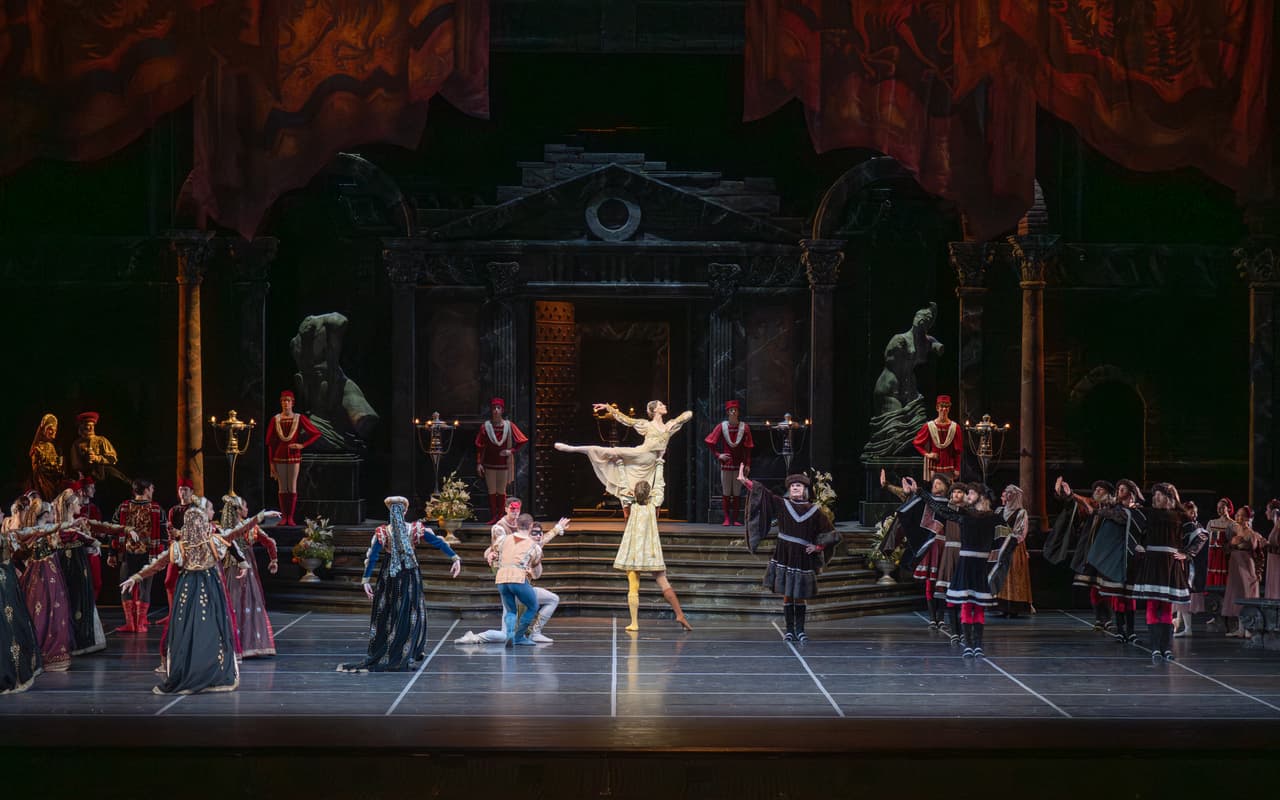
Imagen Dutch National Ballet © Altin Kaftira






Within this world, nobles and commoners collide, lovers and rivals confront one another, and chance encounters and duels drive the drama across all three acts.
On Saturday, October 18, Olga Smirnova and Jacopo Tissi starred as Juliet and Romeo. Smirnova delivered a Juliet both delicate and technically impeccable. Her portrayal, at times reminiscent of Giselle, made her appear to float effortlessly with naturally executed “pas de bourrée couru,” yet she imbued Juliet with playful, intense moments, capturing the exhilaration of first love behind a mask at a ball.
Tissi’s Romeo radiated youthful passion and vulnerability, perfectly capturing the character’s emotional journey from infatuation to desperate love. His partnership with Smirnova was magnetic, every pas de deux conveying intimacy, trust, and the exhilaration of first love.
The corps de ballet is far from mere accompaniment; their coordination was exquisite throughout the performance, particularly in the vibrant Act II village square scene. Among the evening’s highlights were the fencing sequences, where the dancers’ swordplay achieved a rare precision and authenticity.
Tybalt, Juliet’s haughty and defiant cousin, emerged as a standout figure, brought to life by Giorgi Potskhishvili. His technique, dramatic intensity, and physical daring border on the supernatural, confirming the extraordinary capabilities of the human body. The Georgian dancer’s commanding stage presence and flawless execution make him seem to soar, defying gravity and tracing sharp geometric lines with every leap. Yet this is not circus acrobatics: every gesture carries weight, depth, and style, reflecting a mastery that places him among the most accomplished dancers of his generation.
The scene of Tybalt’s death at the close of Act II is one of the ballet’s most powerful moments. The drama and force of the dance fuse seamlessly with Prokofiev’s score, conducted by Koen Kessels with the Dutch Ballet Orchestra, leaving an atmosphere that lingers long after the curtains fall.
This resonance carries into the final scene, as Juliet, in a final act of courage and love-driven madness, takes her life with her beloved’s dagger. Even knowing the ending, it is impossible not to be moved by the Dutch National Ballet’s achievement. As with Shakespeare, by the final curtain, one leaves convinced “ there was no tale of greater woe than this of Romeo and Juliet.”