President Donald Trump will announce a “readjustment” to U.S.-Cuba policy during a visit to Miami on Friday, tightening travel restrictions for Americans visiting the island and banning all financial transactions with Cuba's extensive military-run enterprises.
Trump to restore some restrictions on Cuba travel, targets island's military-run enterprises
The changes leave intact the greatest achievements of Obama’s Cuba legacy, including the restoration of diplomatic ties and the re-opening of the U.S. embassy in Havana, as well as the relaxing of travel restrictions and the reintroduction of regular commercial flights.
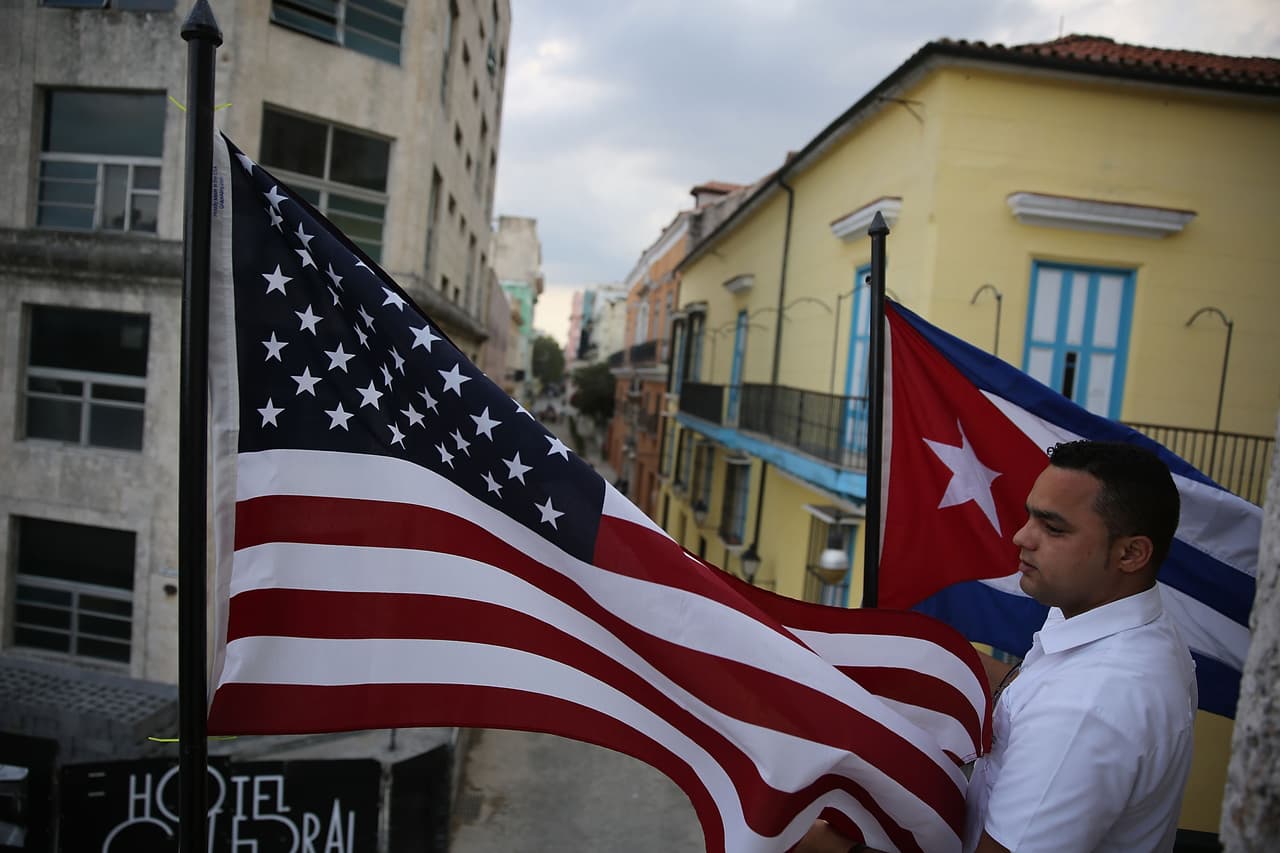
U.S. and Cuban flags in Havana, Cuba.
Imagen Getty Images
"The president vowed to reverse the Obama administration policies toward Cuba that have enriched the Cuban military regime and have increased the repression on the island," a senior White House official said in a conference call on Thursday.
The policy modifications are designed to restore some restrictions loosened by former President Barack Obama under his two-year-old effort to normalize U.S.-Cuba relations.
However, the changes leave intact the greatest achievements of Obama’s Cuba legacy, including the restoration of diplomatic ties and the re-opening of embassises in Havana and Washington, as well as the relaxing of travel restrictions and the reintroduction of regular commercial flights.
Cruise ship packages to Cuba which were launched last year will also be allowed to continue, as well as other commercial operations such as U.S. cellphone roaming in Cuba.
Travel for Cuban Americans and remittances sent to their families will also be unaffected. Trump even appears ready to allow Americans to bring back Cuban cigars and rum.
“It’s not as bad as I had feared, not as good as I had hoped,” said Pedro Freyre, a Cuban-born attorney who heads the international practice at the law firm Akerman in Miami and represents clients interested in doing business in Cuba. "Now we know what the rules are," he added, noting widespread speculation in recent weeks of harsher measures.
Stricter travel
Trump's policy will mean stricter enforcement of regulations governing travel to Cuba by U.S. travelers who are not of Cuban origin.


In future, travelers could be subject to a Treasury Department audit of their trip to check that it meets the permitted categories.
Obama's policy expanded regulations allowing many Americans to visit Cuba for the first time under a dozen categories, such as cultural exchanges, academic research or a loosely-defined purpose known as "people-to-people" travel.
As a result, the number of U.S. citizens traveling to Cuba leapt 74 percent from 2015 to 2016, according to Cuban government statistics.
Under Trump, those traveling in the “people-to-people” category will no longer be able to travel by themselves with their own itinerary, and will have to join a licensed group package.
The policy changes will not go into effect for 90 days while lawyers thrash out the regulatory details.
Trump is due to announce the new policy on Friday, at Miami’s Manuel Artime Theater, named after one of the late leaders of the 2506 Brigade that led the failed 1961 Bay of Pigs invasion of Cuba. During the campaign Trump visited the 2506 Brigade and promised to address their concern about Obama's normalization policy.
White House officials stressed that the new policy is a return to traditional efforts - abandoned by Obama - to force Cuba into abandoning its one-party, communist-run system and hold free, multi-party democratic elections. It also marks a partial victory for hard line Cuban American political leaders, led by Florida Senator Marco Rubio, who are fiercely critical of Obama’s Cuba policy, which was launched in December 2014 after months of secret talks with the Cuban government.
“If we’re going to have more economic engagement with Cuba, it will be with the Cuban people,” Rubio told the Miami Herald.
“All the pressure comes from American business interests that go to Cuba, see the opportunities and then come back here and lobby us to lift the embargo,” Rubio said. “I’m trying to reverse the dynamic: I’m trying to create a Cuban business sector that now goes to the Cuban government and pressures them to create changes."
On twitter Rubio highlighted a quote from a Cuban military website claiming that one military-run tourism company, Gaviota, welcomed nearly half of the visitors to Cuba in 2015.
Military spider's web
Cuba's military holding company, GAESA (Grupo de Administración Empresarial, S.A.), is the island's largest business empire and controls about 50 percent of the economy, according to some estimates.
It comprises at least 57 companies and is headed by Luis Alberto Rodriguez, the son-in-law of Cuban president Raul Castro.
"The Cuban military is an enormous spider that eats the smaller spiders around it," said John Kavulich, a long time Cuba watcher and president of the U.S.-Cuba Trade and Economic Council in New York. "It's appetite thus far has been insatiable," he added.
It was unclear how much the new policy would adversely affect the U.S. businesses that have invested in Cuba in the last two years, such as Airbnb and Google. Limiting individual "people-to-people" travel that could actually hurt Cuba's privately-run Aibbnb network.
A drop in U.S. travel to the island could also affect airlines that have begun flying to destinations across the island from a dozen U.S. cities.
The policy includes some exemptions including U.S. exports of agriculture and medicines via the military-run port of Mariel.
Critics of reversing Cuba policy point out that Obama's policy has enjoyed strong support nationally as well as among Cuban Americans.
"Don't be fooled. The Cuban people overwhelmingly want engagement with the U.S. - they know better than Trump what they need," " tweeted Ben Rhodes, who was Obama's senior adviser and former Cuba negotiator.
The new policy is also unlikely to push Cuba to reform, critics say. ""The Cuban system has proved its resilience to U.S. attempts at isolation over the past five decades," said Jason Marczak with the Atlantic Council, a Washington think tank that favors engagement with Cuba.
"A backtrack in our Cuba policy will only give new anti-US ammunition to countries like Venezuela, while making the U.S. approach to Cuba increasingly hard to defend among our allies."
Video “It would be horrible to reverse course:” Cuba’s private sector fears arrival of Trump
Relacionados: