

SOMERSET COUNTY, New Jersey. -- As major pharmaceutical companies across New Jersey race to find a vaccine to the coronavirus, there's a tiny bat that flies over their wooded campuses on the occasional evening that could teach us how to deal with the ongoing pandemic.
Bats are social distancing to avoid a deadly disease -- just like us
Bats are being vilified right now, because scientists suspect the coronavirus originated from them in China. But ironically, the experience of an American bat species could teach us about dealing with the coronavirus. Lee este artículo en español.
Video Video: Just like humans, bats are social distancing to avoid a deadly disease
It's the little brown bat, a furry creature that once roamed all over the suburbs -- that is, until a quickly spreading fungus appeared and nearly killed them all.
But it's the way these bats have reacted to their own pandemic that's worth noting.
"What we found is that bats were social distancing," said Kate Langwig, a biology professor at Virginia Tech.

Copyright Michael Schirmacher, Bat Conservation International
Imagen A little brown bat sick with White Nose Syndrome.





She's the lead author of a 2012 study that discovered a massive segment of this bat population decided to hibernate alone after the appearance of this deadly disease.
"Bats were actually spreading apart such that more individuals were roosting alone inside these caves than have ever roosted alone before," Langwig told us.
The extent of the shift is striking. Before the appearance of this deadly fungus, only 1 out of every 100 little brown bats were solitary. When the sickness started spreading, nearly half of them went solo.

A sick little brown bat being examined by a researcher.
Imagen Jonathon Reichard and Boston University; Bat Conservation International
To a bat, failing to act ensures a certain doom. White Nose Syndrome causes bats to rouse repeatedly during hibernation, depleting their fat reserves. When a healthy bat gets sick, it's likely to starve. And the disease spreads rapidly through skin contact, which these cuddly creatures love. (Some spots in New York serve as a myotis metropolis, with upwards of 100,000 dwelling in a single cave.)
But there's actually a more significant lesson here. Since that study, researchers have discovered that the little brown bat didn't act with enough speed. By the time bats started isolating themselves, they had already been spreading the fungus for months.
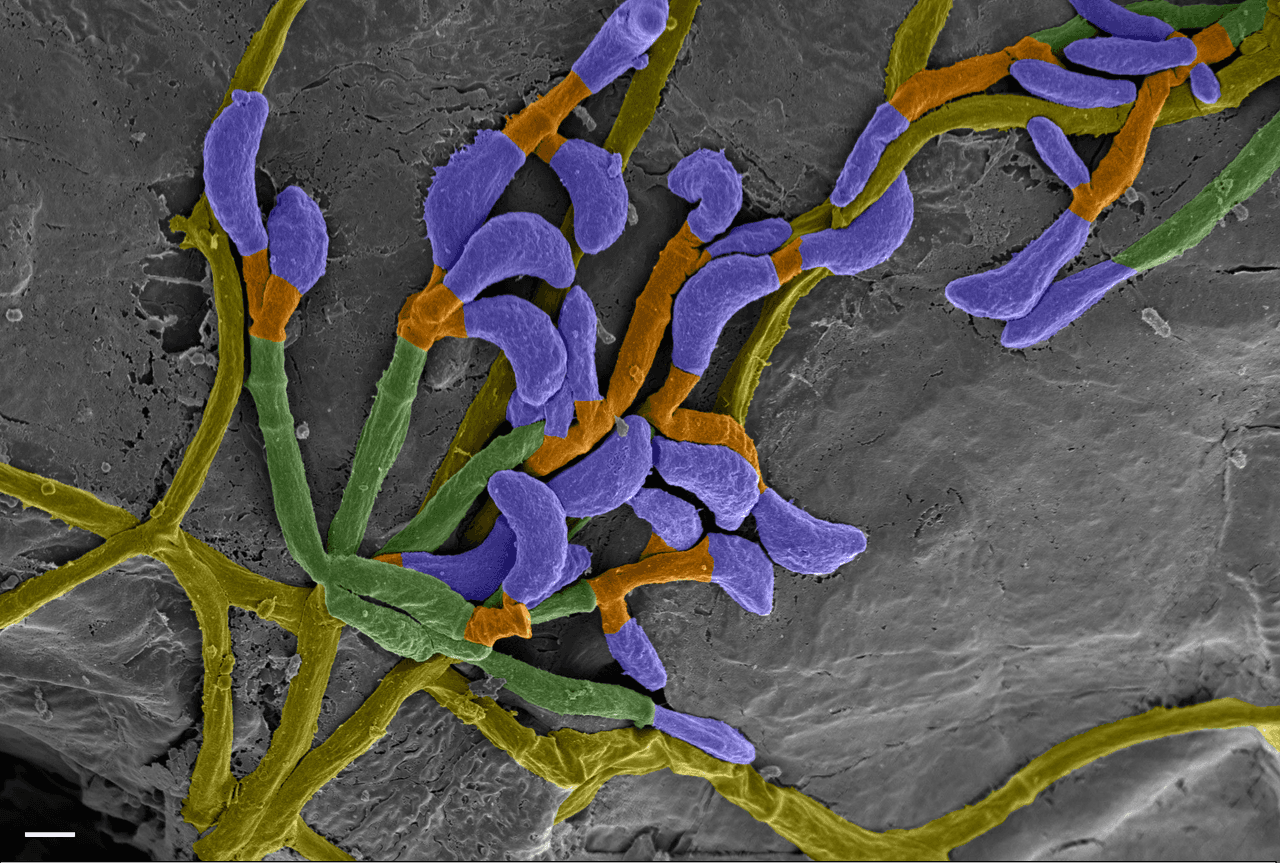
Pseudogymnoascus destructans
Imagen Deborah J. Springer
"Unfortunately, the social distancing wasn't happening enough," Langwig said. "Because just like COVID-19, if we only stay home when we're really sick, we can still get a lot of spread. Staying home when you're sick isn't enough."
Humans aren't the only ones experiencing a significant cost by staying away from each other. Some little brown bats decide to avoid caves and hibernate in the trees, taking their chances by exposing themselves to a frigid winter instead of this disease.
"We are complaining about a couple of months of social distancing, when bats have been carrying out this practice of social distancing for years to avoid this disease," said Dr. Jorge Ortega, a biologist at the National Polytechnic Institute at Mexico City. "We need to learn to be patient. We need to learn that our lifestyle will change. That is, we can't return to the regular activities we did before quarantine."
And while bats make for an ironic example -- given that the species is believed to be the supposed origin of the SARS-CoV-2 virus in China -- they're not the only ones making these monumental individual sacrifices for the survival of the group.
"There are lots of social animals out there, and in almost every type of social animal we see behaviors that are much like social distancing," said Dana Hawley, a biological sciences professor at Virginia Tech.
She noted that researchers observe these changes in lobsters, insects, amphibians, birds, fish, and monkeys. "Everywhere that we've really looked closely, we find that animals change their social behavior when disease is in their midst."

Little brown bats that are clearly not practicing social distancing.
Imagen Copyright Michael Schirmacher, Bat Conservation International
Relacionados: