
Hurricane Matthew, a major Category 4 storm, blew over the southwestern peninsula of Haiti early Tuesday with "devastating" force, flooding coastal towns and ripping roofs off buildings.
Hurricane Matthew blasts over southwest Haiti, glances Cuba
Matthew is the most powerful hurricane to hit Haiti in 52 years. It glanced the eastern tip of Cuba, before aiming at the Bahamas and Florida.
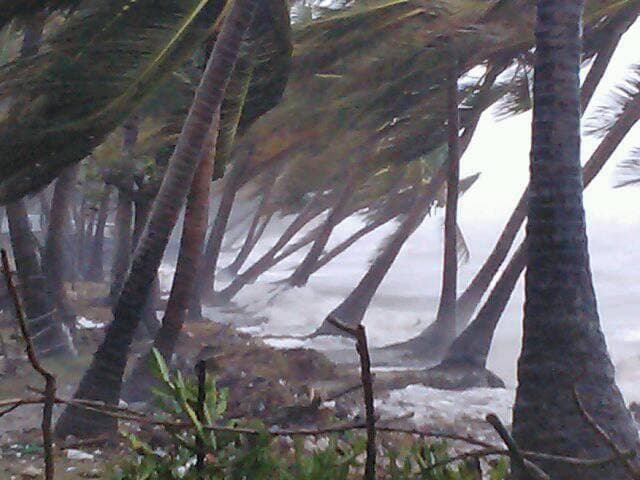
On Monday afternoon winds from Hurricane Matthew began to whip up seas on Ile-a-Vache, a small island off the southwest coast of Haiti with about 10,000 residents.
Imagen Makenley Loussaint
The poorest country in Latin America is ill-prepared to withstand the hurricane force winds and massive storm surge predicted by forecasters. Towns and villages in the rural south-west of Haiti braced for its impact, fearing their crops will be wiped out, including some of the island's best coffee plantations.
Some people took refuge in schools and churches, but Haiti's cash-strapped government has one of the hemisphere's least equiped civil protection and disaster management services, with woefully few hurricane shelters.
There were early reports of widespread damage to homes in the city of Les Cayes and on the island of Ile-a-Vache, known for its beautiful undeveloped beaches. The entire southwest of haitik was left incommunicado for hours after the storm passed and details of the damage were slow to trickle out.
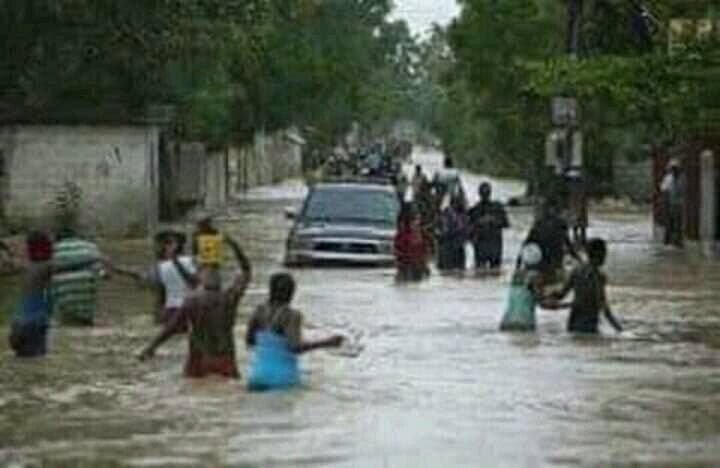
Residents waded through flooded streets in the southwestern city of Les Cayes
Imagen Noel Gespere
"The situation in Les Cayes is catastrophic, the city is flooded, you have trees lying in different places and you can barely move around, the wind has damaged many houses," Deputy Mayor Marie Claudette Regis Delerme, who was forced to flee a house in the town of about 120,000 when the roof was torn off, Reuters reported.
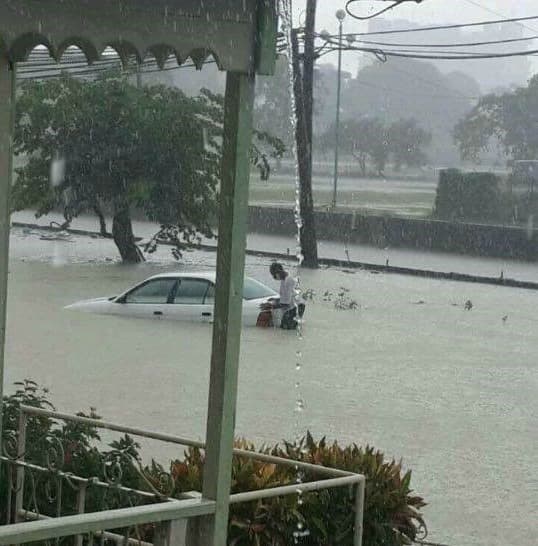
Matthew left the city of Les Cayes flooded.
Imagen Noel Gespere
Matthew also left the southwestern peninsula cut off from the rest of the country. A bridge in the flooded town of Petit Goave was destroyed, severing the only road to Les Cayes, complicating the relief effort.
One hotel owner on Ile-a-Vache said the island's mayor, Jean-Yvres Amazan, told him by phone "every home in his neighborhood, including his own, is damaged. Most roofs are gone."
"This weather has been hitting them hard for the past three days, therefore people are running out of food," said Patrick Lucien, owner of Vacation Village, a small hotel on the island which also suffered damage.
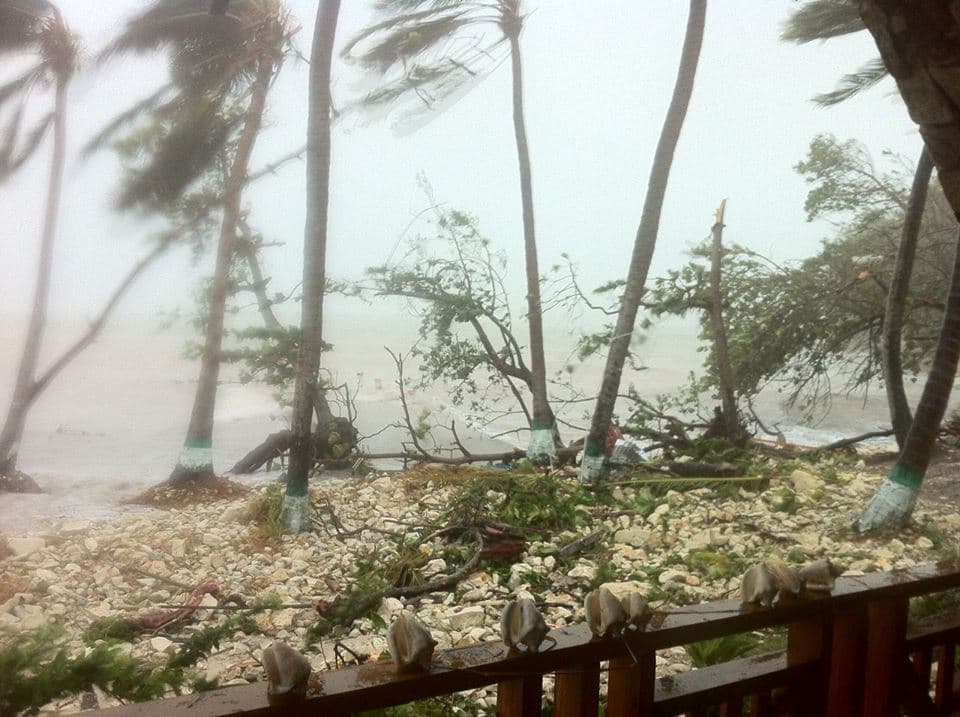
Damage was reported to buildings at Vacation Village, a small hotel on the island of Ile-a-Vache, where 26 people took refuge Monday night. Ile-a-Vache is a small island of 10,000 people off the southwest coast on Haiit. This photos was taken Tuesday morning as Hurricane Matthew made landfall.
Imagen Patrick Lucien


While there remains significant uncertainty about the track of Matthew in the long range, the threat to Florida and the southeastern U.S. coast also increased on Tuesday, according to the U.S. National Hurricane Center. A hurricane watch was decared for a large part of the Florida east coast from Deerfield Beach to St Augustine. Miami was under a tropical storm watch.
Matthew is the third strongest one ever recorded in the impoverished nation, and the strongest to hit Haiti in 52 years, according to Jeff Masters, a widely read-meterologist with the Weather Underground blog.
"Matthew’s track is close to a worst-case scenario for the beleagured nation of Haiti, as it will bring the hurricane’s more dangerous right-hand side across Hispaniola," wrote Masters. "Far southwest Haiti may experience Matthew’s small core of intense hurricane-force winds, and a much larger area of powerful south winds slamming against tall mountainsides will lead to phenomenal rains over Haiti as well as much of the Dominican Republic," he added.
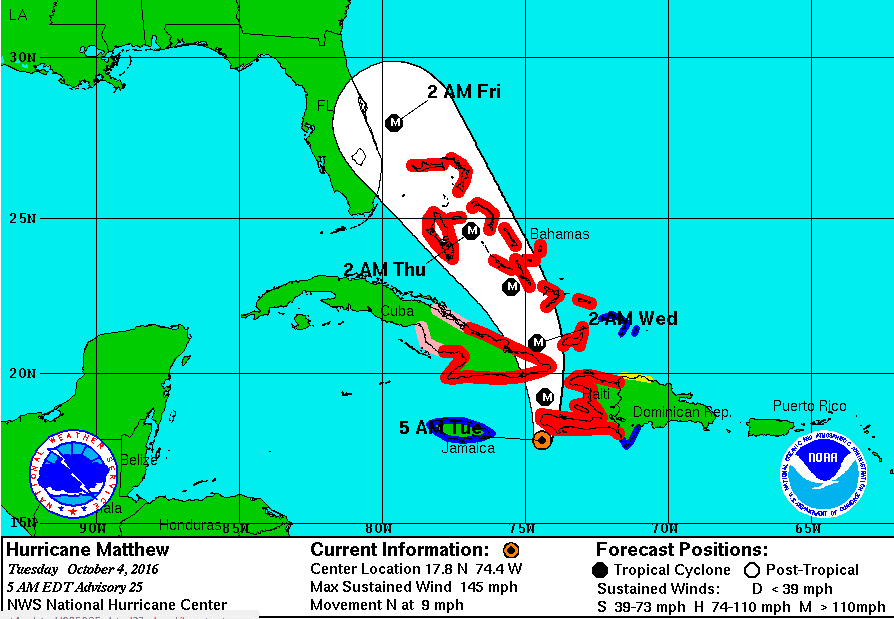
The track of Hurricane Matthew threatens western Haiti and eastern Cuba, as well as the Bahamas. The risk is also growing for Florida and the Southeast United States.
Imagen National Hurricane Center (NHC)
"We have gusts of wind hitting the whole area and the people have fled to a shelter," Les Anglais mayor Jean-Claude Despiser told Reuters. In the nearby town of Tiburon, the mayor said people who had been reluctant to leave their homes also ran for cover when the sea rose. "Everyone is trying to find a safe place to protect themselves, the situation is very difficult," Mayor Remit Denizen said, describing large waves hitting the town.
Concern was greatest for coastal cities on Haiti's southwest peninsula, including Les Cayes, with a population of about 140,000. The NHC said the center of Matthew made landfall early Tuesday near the small town of Les Anglais, about 35 miles west of Les Cayes.
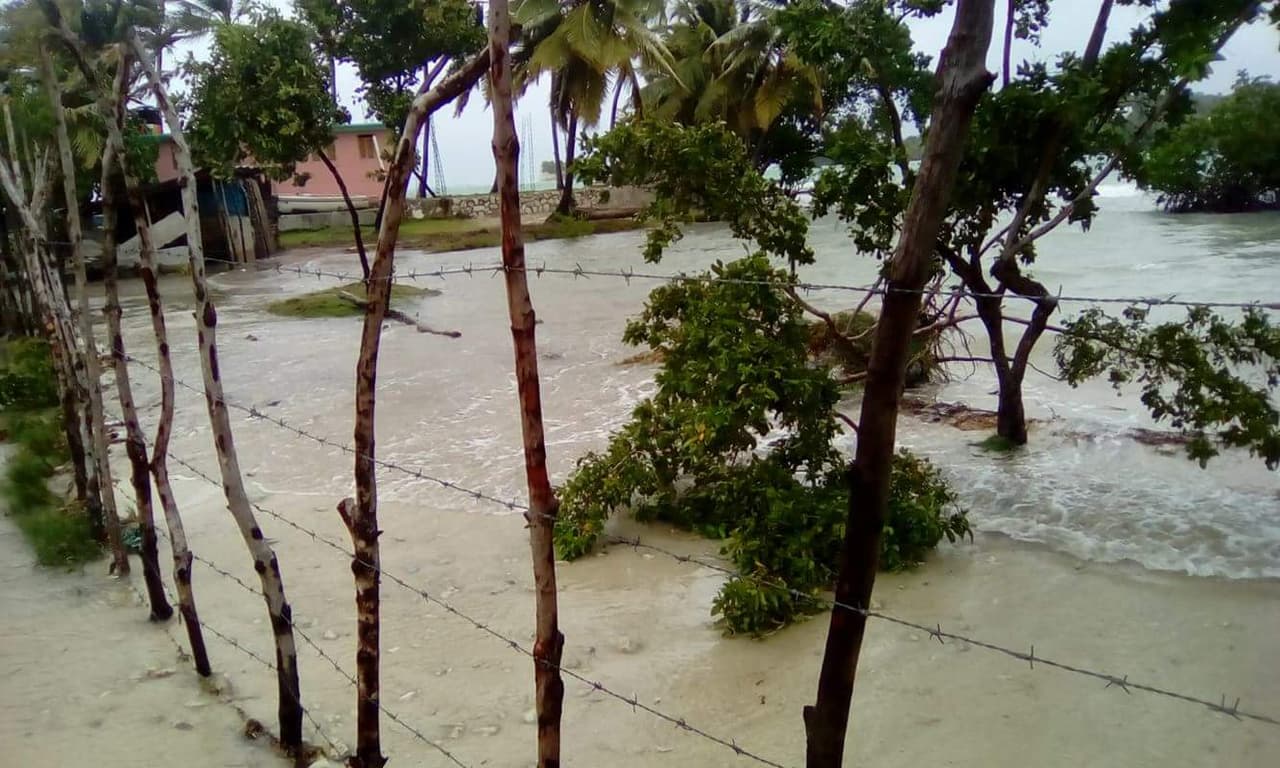
Photo of flooding on Monday in Ile-a-Vache, as the outer bands of rain from Hurricane Matthew begin to impact Haiti.
Imagen Weldy Altema
Hurricane-force winds extend outward up to 40 miles from the center of Matthew and tropical-storm-force winds extend outward up to 185 miles, the NHC said.
Morgan Wienberg, 24, the founder of Little Footprints, Big Steps, a safe house for orphans and homeless children in the city of Les Cayes, said she spent about 10 hours on Monday relocating children and families to safer locations in preparation for the hurricane.
"We were able to evacuate approximately 50 people, primarily young children, mothers and babies, from highly vulnerable areas and place them in temporary shelters where they will be safer," she said. "We were able to do the same with several street children," she added.
She worrried about others in poor, rural communities who may not even be aware the storm is coming.
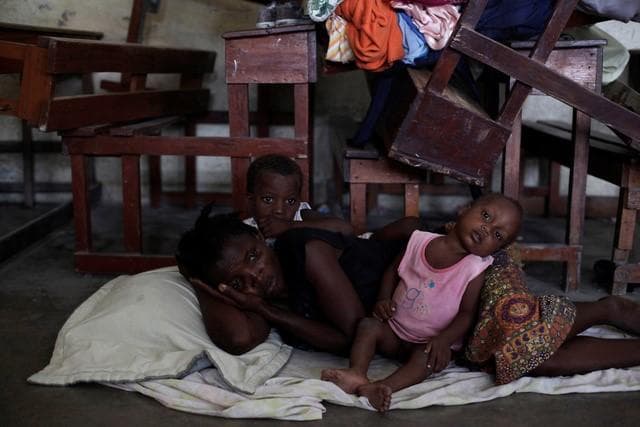
A woman with two of her children rest on the floor at the shelter set up in a school ahead of Hurricane Matthew in Les Cayes, Haiti, October 3, 2016.
Imagen REUTERS/Andres Martinez Casares
While southwest Haiti is mountainous and sparsely populated it is a fertile region that survives on agriculture, Matthew was also expected to impact cities up and down Haiti's west coast, including the capital, Port-au-Prince where thousands left homeless by a 2010 earthquake are still living in tents.
The notoriously overcrowded seaside slums in the capital Port-au-Prince were also at risk. Frederic Hislain, the mayor of the largest slum, Cite Soleil, told Reuters 150,000 people needed to be evacuated.
"Those people are living all along the seashore in a bunch of huts which usually can't even really protect them from ordinary rain. Now we are talking about a strong hurricane. Imagine the disaster we may have to face here," he said.
While authorities warned residents to evacuate few have their own means of transport and the government doesn't have the resources to provide buses to move them.
With up to 40 inches of rain forecast from the slow moving hurricane, authorities also warned of slums being engulfed by mudslides due to decades of deforestation on the mountainsides overlooking the capital.
Matthew could restrengthen after passing over Haiti and Cuba, threatening the Bahamas and the Carolinas on the U.S. east coast, according to Masters. Hurricanes gain their energy from water vapor evaporating from a warm ocean surface.
The last major hurricane in the Caribbean was Sandy in 2012 which caused major damage in Santiago de Cuba, before heading north to New York where it caused massive flooding.