Two impressive debuts that resonated over three consecutive nights at the Lincoln Center. Last week, Colombian conductor Andrés Orozco-Estrada, a well-known Latino figure in the orchestral world, had his momentous night in the Big Apple: he conducted the renowned New York Philharmonic for the first time.
New York Philharmonic: Orozco-Estrada Brings the Heat and Flavor of Colombia to Lincoln Center
Last week, Colombian conductor Andrés Orozco-Estrada, a well-known Latino figure in the orchestral world, had his momentous night in the Big Apple: he conducted the renowned New York Philharmonic for the first time.

Por:
Lioman Lima, from New York
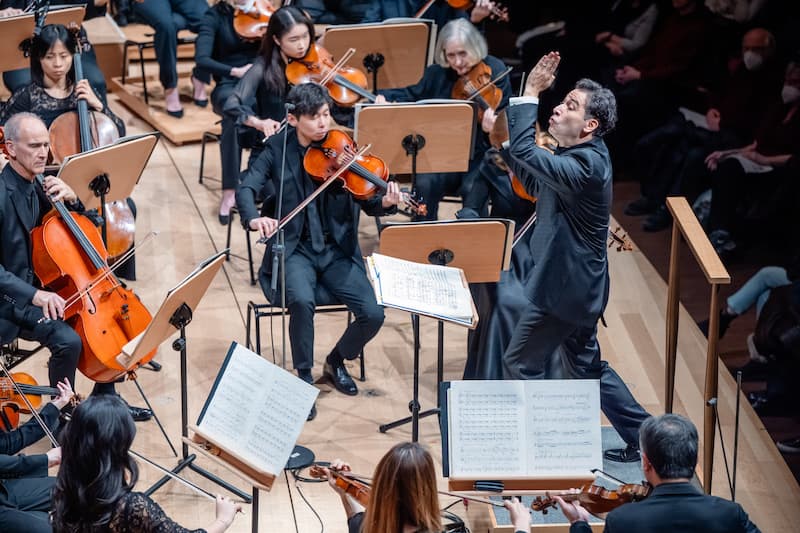
Edgar Moreau makes his NY Phil debut in Haydn’s spirited Cello Concerto No. 1. Leading the Orchestra for the first time, Andrés Orozco-Estrada conducts Tchaikovsky’s passionate take on the tragedy of Romeo and Juliet, Enescu’s Romanian Rhapsody No. 1, and Bartók’s The Miraculous Mandarin Suite — an orchestral adaptation of the composer’s scandalous 1926 pantomime.
Imagen Brandon Patoc
This marked a virtuoso year-end closing for Orozco-Estrada, who took over the reins of the RAI Orchestra just a couple of months ago following an abrupt departure from the Vienna Philharmonic in 2022. His performance at the David Geffen Hall was characterized by an energetic, buoyant, and warm program, momentarily distracting the audience from the biting cold that had begun to settle in New York last week.
The opening piece was Tchaikovsky's Overture-Fantasy of Romeo and Juliet, the often misunderstood composition that received a chilly reception at its premiere in 1870. The score, revised multiple times by Tchaikovsky, who never seemed entirely satisfied with it, took on new dimensions in its interpretation by the New York Philharmonic, receiving a much different reception than its Moscow premiere.


Orozco-Estrada skillfully conveyed a variety of tones and emotions through his conducting, ranging from the evocative to the hallucinatory and the tragic in the fate of the "lovers of Verona." The conductor's orchestration, combined with the talent of his musicians, led to climactic moments and others of evocative delicacy, almost perceptual.
Undoubtedly, the overture served as the perfect prelude to the main event—and the second debut of the night: Haydn's Cello Concerto No. 1, performed by a 29-year-old musician who appears to master the cello with youthful vigor and the technique of the greats composers of the Baroque era: Edgar Moreau.
Haydn's concerto, a complex and vibrant piece lost for centuries and rediscovered just over 60 years ago, provided Moreau the opportunity to showcase his skills and virtuosity. It was a combination of great musical moments that elicited applause from the audience, with some even rising to their feet.
Moreau, with red socks and matching soles, lost a few notes in his enthusiasm, although they were almost imperceptible. He returned with an encore, once again demonstrating his prowess, this time with the Sarabande from Bach's Cello Suite No. 3. He played it with abandon and freedom, conveying a supreme enjoyment of music that became contagious in the audience.
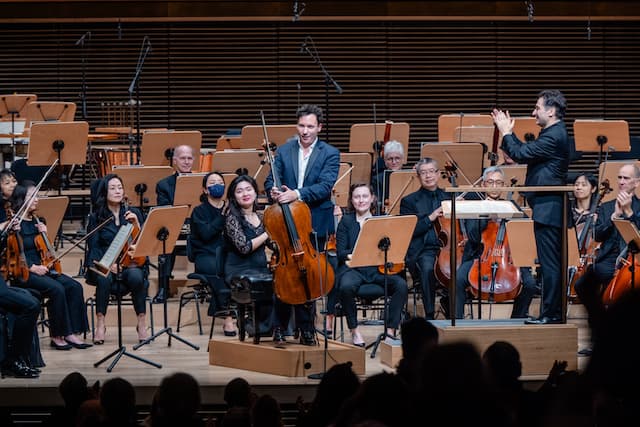
Edgar Moreau makes his NY Phil debut in Haydn’s spirited Cello Concerto No. 1. Leading the Orchestra for the first time, Andrés Orozco-Estrada conducts Tchaikovsky’s passionate take on the tragedy of Romeo and Juliet, Enescu’s Romanian Rhapsody No. 1, and Bartók’s The Miraculous Mandarin Suite — an orchestral adaptation of the composer’s scandalous 1926 pantomime.
Imagen Brandon Patoc
Equally extraordinary was Orozco-Estrada's interpretation of Bartok's Suite for the Miraculous Mandarin, an overwhelming and unrestrained piece that the orchestra handled with balance, avoiding the risk of one instrument overpowering the others.
It was a moment for the brass section to shine, and Orozco-Estrada skillfully made it them play with the rigor of classical music but also with notes that reminded us the flavor and moves of music of his native Colombia.
And what begins joyfully, ends joyfully: for the finale, there was Enescu's florid Romanian Rhapsody No. 1, reaffirming the celebratory spirit that marked the entire concert—much like Orozco-Estrada seemed to reaffirm with his dance-like movements -. It was a strictly classical and festive performance, but it also showed the warmth accents of Latin America in the cold night of New York.